
Note-Taking Systems Compared: Cornell, Outline, Mind Mapping, and More
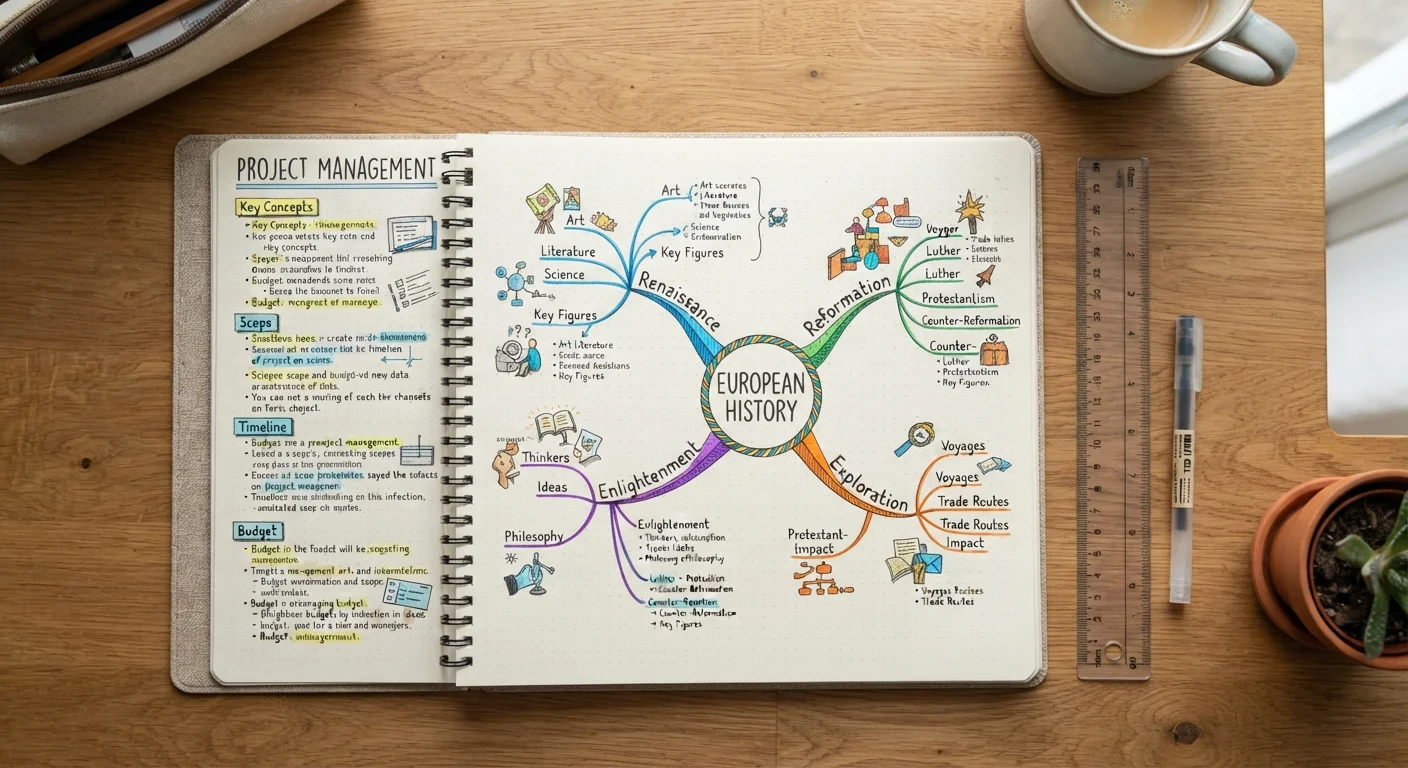
Photo credit: FaqsInsights.com | Stay Informed, Stay Ahead
In this article
An honest comparison of widely used note-taking frameworks to help students choose the approach that fits their subject and learning goals.
Key Takeaways
- No single note-taking system works best for every subject or learner - context matters.
- The Cornell Method builds active recall into its structure, supporting long-term retention.
- Mind mapping is well-suited for brainstorming and understanding relationships between ideas.
- Outline notes excel in lectures with clear hierarchical structure.
- Switching systems based on the task, not habit, is often the most effective approach.
Why Your Note-Taking System Matters
Research on learning consistently shows that how you record information shapes how well you retain it. Note-taking isn't just transcription - it's a cognitive act. But with so many frameworks circulating in study guides and classrooms, it can be hard to know which one actually fits your situation.
This comparison covers four widely used systems: the Cornell Method, the Outline Method, Mind Mapping, and the Sentence Method. Each is evaluated on structure, flexibility, review efficiency, and the types of content it handles best. For a deeper look at the medium you choose for any of these systems, see our comparison of digital vs. paper notes.
| Cornell Method | Outline Method | Mind Mapping | Sentence Method | |
|---|---|---|---|---|
| Best content type | Factual, lecture-based | Structured, hierarchical | Conceptual, relational | Fast, unstructured |
| Ease of use during lecture | Moderate | High | Low to moderate | High |
| Review efficiency | High - built-in self-test | Moderate | Moderate | Low - requires reorganizing |
| Supports active recall | Yes, by design | Partially | Partially | No |
| Flexibility | Low to moderate | Low | High | High |
| Ideal learner style | Analytical, exam-focused | Sequential, organized | Visual, creative | Any - capture-first priority |
The Cornell Method: Structure That Supports Review
Developed at Cornell University in the 1950s, this system divides a page into three zones: a narrow left column for cues or questions, a wide right column for notes taken during the lecture, and a summary box at the bottom completed after class.
The design is intentional. After a session, you cover the main notes and use your cue column to quiz yourself - a practice aligned with the well-studied testing effect, which suggests that retrieving information strengthens memory more than re-reading does. The summary section encourages synthesis rather than passive transcription.
Maximize Cornell Notes with Spaced Review
The Cornell system gains most of its power when you return to your notes within 24 hours of a lecture to complete the summary section and cue column. Reviewing again before the next class - and once more before an exam - aligns with spaced repetition principles shown to improve long-term retention. Treat the summary box as a miniature self-quiz, not just a recap.
Best for: Sciences, history, and any subject with dense factual content where self-testing during review is a priority.
Limitation: The format can feel rigid in highly visual or concept-driven subjects where relationships between ideas matter more than hierarchical facts.
The Outline Method: Clean Hierarchy for Structured Content
The Outline Method organizes notes into a tiered structure - main topics at the top level, sub-points indented below, and supporting details indented further. It mirrors how textbooks and many formal lectures are already arranged.
Its strength is speed and clarity. When a professor follows a logical sequence, outlines keep pace without requiring much structural thinking in the moment. Reviewing is straightforward because the hierarchy makes relationships explicit.
Best for: Readings with clear chapter structure, lectures that follow an agenda, and law or humanities coursework where argument hierarchy matters.
Limitation: Outlines break down when content doesn't arrive in a neat hierarchy - fast-moving discussions, lab-based work, or interdisciplinary material can feel forced into the format.
Mind Mapping: Visual Thinking for Complex Connections
Mind mapping places a central concept at the page's center, then branches outward to related ideas, sub-topics, and associations - often using color, symbols, or images to reinforce connections. The format is non-linear by design.
This approach is particularly useful when you need to understand how ideas relate rather than memorize what they are in sequence. It's also a strong brainstorming tool for essay planning or project scoping.
Best for: Biology, philosophy, literature analysis, creative projects, and any context where visualizing relationships between concepts aids understanding.
Limitation: Mind maps are harder to produce quickly during a live lecture and can become visually cluttered without deliberate editing afterward. They are also less effective when reviewing linear or procedural material.
The Sentence Method and Choosing Strategically
The Sentence Method involves writing each new thought, fact, or point as a separate numbered sentence - no hierarchy imposed, no branching. It prioritizes capture speed over organization.
It's rarely anyone's long-term favorite, but it serves a real purpose: when content arrives faster than any structure can keep up with, this method ensures nothing is lost. The trade-off is that review requires a second pass to impose organization retroactively.
Best for: Fast-paced seminars, field notes, or situations where capturing detail is the immediate priority.
Ultimately, experienced learners tend to rotate systems based on context rather than adopting one method universally. Pairing your note-taking approach with a deliberate study routine can further amplify results - our pre-session self-check offers a practical starting framework. If you're also thinking about how to structure your thinking in other domains, similar principles of matching format to function apply - much like the trade-offs explored in comparing study time-management methods.

Author
Learning & Education Editorial Team
Learning & Education Editorial Team is the collective byline for our editorial team and contributor network. Articles published under this byline or an editorial pen name are researched, written, and reviewed according to our editorial standards for clarity, consistency, and independence before publication.
View all articles →