
Interior Paint vs. Primer-and-Paint Combos: Understanding the Real Trade-Offs
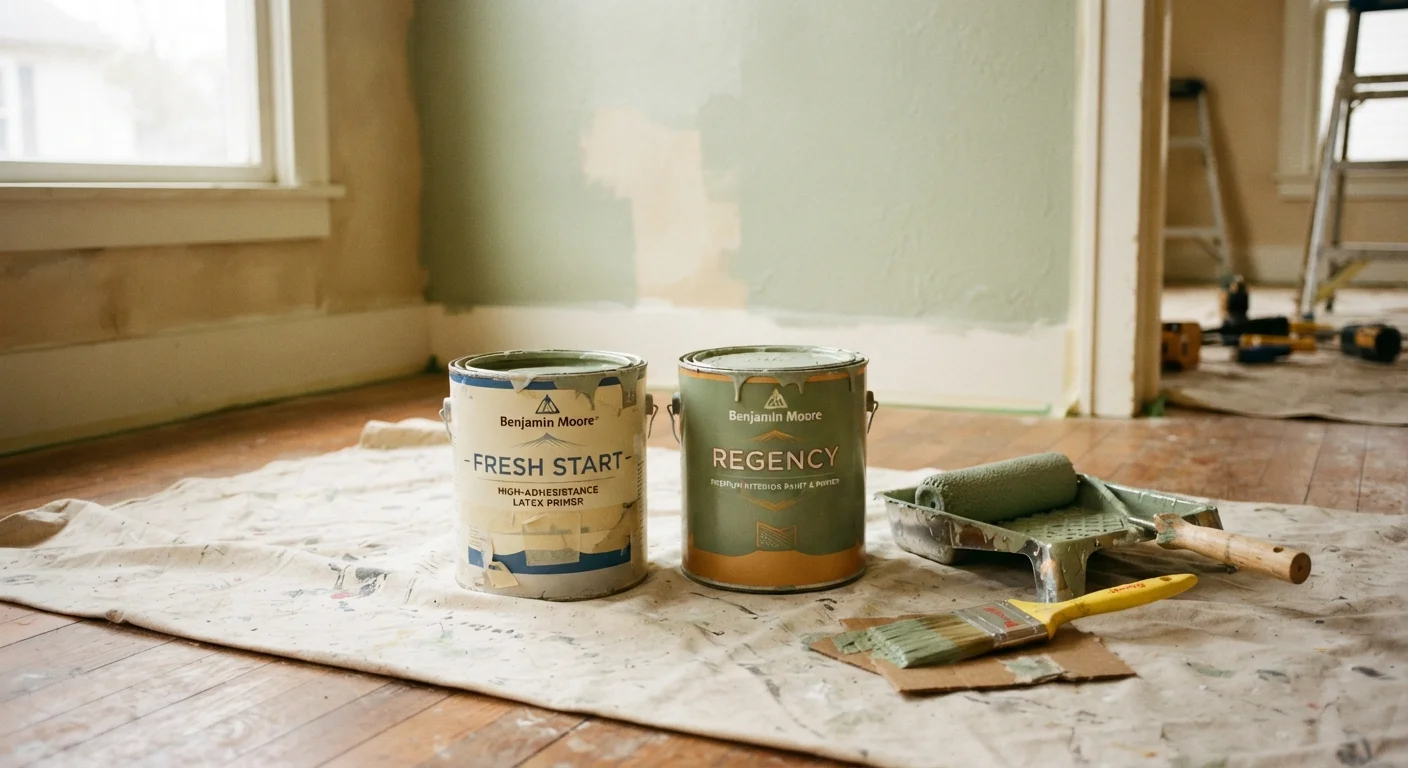
Photo credit: FaqsInsights.com | Stay Informed, Stay Ahead
In this article
Paint-and-primer products promise convenience, but they're not always the right call. Understand when separate primer coats genuinely make a difference.
Key Takeaways
- Paint-and-primer combos work well on already-painted, clean, and stable surfaces.
- New drywall, bare wood, and stained walls almost always benefit from a dedicated primer coat.
- Separate primer provides stronger adhesion and better stain-blocking than most combo products.
- Combo products can reduce the number of finish coats needed in low-challenge repainting scenarios.
- Surface condition - not product marketing - should drive your primer decision.
What's Actually Inside a Paint-and-Primer Combo?
The phrase "paint and primer in one" is a marketing descriptor, not a chemical category. These products are latex paints formulated with higher solids content - meaning more pigment and binding resins - than standard interior paint. That additional thickness helps them grip existing surfaces more aggressively and build opacity faster. What they are not is a physical layer of primer somehow blended into the can.
Dedicated primers, by contrast, are engineered specifically for adhesion and sealing. Shellac-based and oil-based primers chemically bond to difficult surfaces, block stains from migrating, and create a uniform porosity that gives your topcoat something consistent to grab onto. That purpose-built chemistry is the key advantage a combo product can't replicate.
Spot Priming Is a Practical Middle Ground
You don't have to choose between priming the entire room or skipping primer entirely. Spot priming - applying a dedicated primer only to repaired patches, stains, or bare areas - is a widely used professional technique. It addresses adhesion and sealing where the wall actually needs it, then a combo or standard paint covers the rest. This approach saves time and product while still managing the surface conditions that a combo product can't handle alone.
Head-to-Head: Where Each Approach Wins
The table below breaks down the practical differences across the most common homeowner scenarios. Neither product wins unconditionally - the right choice is determined by the wall in front of you.
| Criterion | Separate Paint + Primer | Paint-and-Primer Combo |
|---|---|---|
| New drywall or bare surface | Excellent - dedicated PVA primer seals uniformly | Poor - uneven absorption causes flashing |
| Stain blocking (water, smoke) | Excellent with shellac or oil-based primer | Poor - latex base allows bleed-through |
| Previously painted, stable walls | Good - adds adhesion, possibly unnecessary | Good - designed for this scenario |
| Drastic color change | Excellent - tinted primer reduces finish coats | Fair - may require 3+ coats |
| Number of drying cycles required | More - separate primer + finish coats | Fewer - skips dedicated primer step |
| Cost per project | Moderate - two products purchased | Moderate - one premium product |
| Ease of use for beginners | Moderate - two-stage process | High - simplified workflow |
Notice that combo products hold their own in the "coverage" and "convenience" rows, but separate primer holds a decisive lead wherever surface condition is challenging. That pattern reflects the core trade-off: you're exchanging chemistry for convenience when you go combo.
Situations Where Separate Primer Is Worth the Extra Step
New drywall and joint compound: Drywall faces and compound patches absorb moisture at dramatically different rates. Without a dedicated PVA (polyvinyl acetate) drywall primer to equalize that absorption, your finish coat will flash - drying visibly darker or shinier over the patches. Combo products can't seal this disparity reliably.
Water stains and smoke damage: These stains are oil- or protein-based and will bleed through any water-based product, including high-solids combo paints. A shellac-based primer is the only dependable barrier before your topcoat goes on.
Glossy or slick existing paint: Painting over a glossy surface requires either mechanical scuff-sanding or a bonding primer. The extra solids in a combo product don't overcome the adhesion challenge that gloss creates.
Drastic color changes: Going from a deep burgundy to a crisp linen white? A gray-tinted primer coat dramatically reduces the number of finish coats needed. Even two coats of a premium combo product may not fully neutralize a strong underlying color without that intermediate step.
When Combo Products Deliver on Their Promise
Combo products perform genuinely well in the scenario that describes most repainting projects: a previously painted wall in decent shape, with no stains, in a color transition that isn't dramatic. In that context, a quality combo product applied in two coats typically produces a durable, attractive finish without a separate priming step.
They're also a practical option when you're refreshing trim that's already painted in a similar sheen level, or touching up scuffed walls in the same color family. For rental property refreshes or seasonal redecorating where the walls are fundamentally sound, the time savings are real.
2-3 coats
Typical finish coats over unprepared new drywall
Paint professionals generally estimate that skipping a dedicated drywall primer adds one to two additional finish coats to achieve even coverage.
1 coat
Shellac primer coats needed to seal most water stains
A single coat of shellac-based primer is widely cited in trade practice as sufficient to block most household water and smoke stains before topcoating.
The practical takeaway: assess the wall first. Run your hand across it. Look for stains, patches, or gloss. If the surface is stable and clean, a combo product is a reasonable shortcut. If it shows any of the problem signs above, reach for the primer first.
Planning Your Project: A Practical Decision Framework
Before purchasing anything, answer these four questions about your surface:
- Is it previously painted or bare? Bare drywall, plaster, or wood almost always needs a dedicated primer.
- Are there stains, repairs, or moisture history? If yes, dedicate a primer coat to those spots at minimum - spot-priming is a valid middle-ground approach.
- What is the sheen level of the existing paint? Eggshell over flat is low-risk. Satin over high-gloss without prep is a peel risk regardless of combo or separate product.
- How significant is the color shift? More than two LRV (Light Reflectance Value) steps - a rough guide to how light or dark a color is - and a tinted primer will save you coats overall.
If you answer "no problem" to all four, a paint-and-primer combo is a sound, efficient choice. If one or more raises a flag, factor in the separate primer step. The material cost of a quart of primer is modest compared to the labor of applying three or four topcoats trying to compensate for skipping it.
For context on how weighing trade-offs applies in other areas of home and life decisions, see how similar cost-versus-benefit thinking plays out in our overview of new car vs. used car trade-offs.

Author
Home & Garden Editorial Team
Home & Garden Editorial Team is the collective byline for our editorial team and contributor network. Articles published under this byline or an editorial pen name are researched, written, and reviewed according to our editorial standards for clarity, consistency, and independence before publication.
View all articles →