
The Science Behind Why Spaced Repetition Works
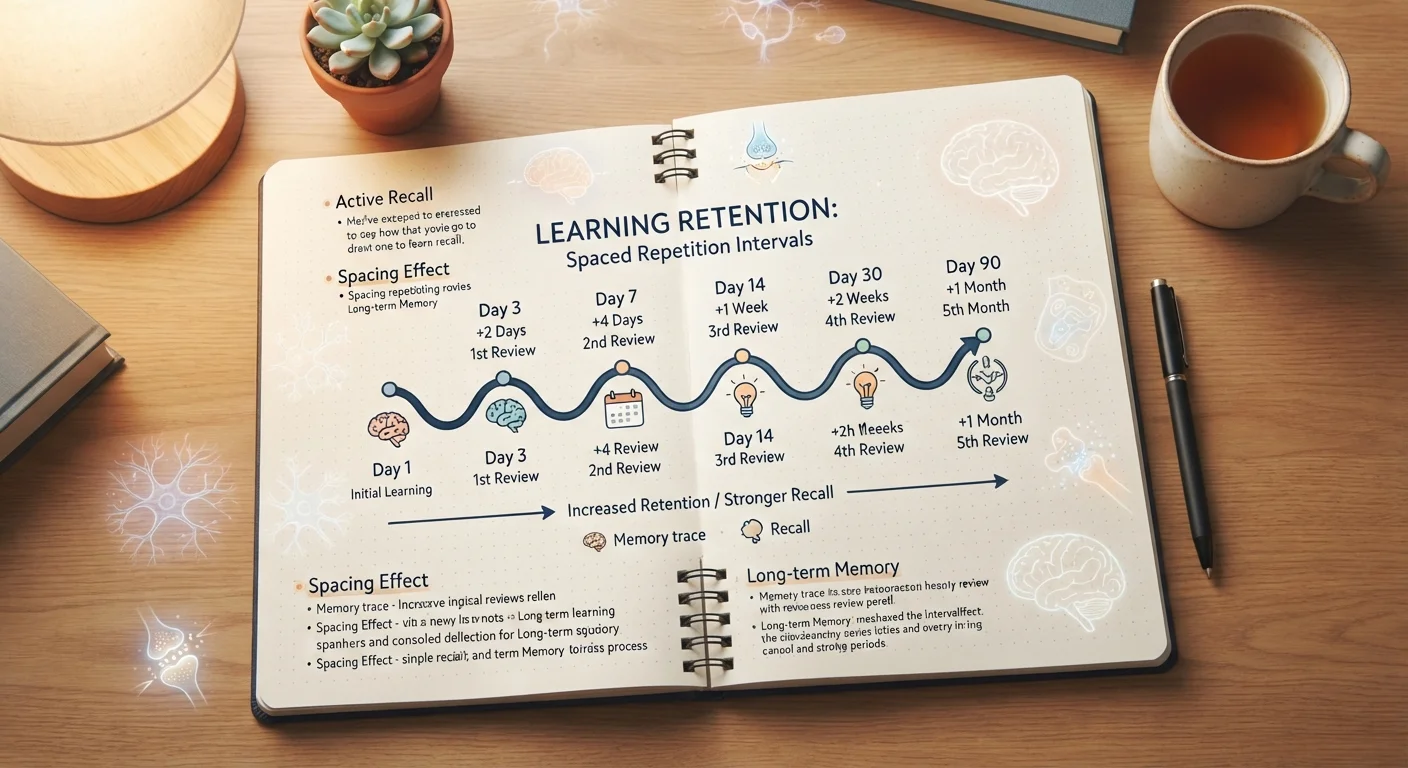
Photo credit: FaqsInsights.com | Stay Informed, Stay Ahead
In this article
Explore the cognitive research explaining why spreading out study sessions dramatically improves long-term memory retention.
Key Takeaways
- Reviewing material at increasing time intervals strengthens long-term memory more effectively than cramming.
- The 'forgetting curve' shows memory decays predictably; spaced review interrupts that decay.
- Each successful retrieval attempt physically strengthens neural pathways in the brain.
- Spaced repetition works best when combined with active recall rather than passive re-reading.
- The technique is effective across subjects, age groups, and skill types.
What Happens in the Brain When You Space Out Study
Every time you encounter and recall information, neurons in your brain form or reinforce connections called synapses. The strength of those connections - and therefore how reliably you can retrieve the memory - is directly related to how often and under what conditions you've retrieved it before.
When you cram, you revisit material while it's still fresh, which requires minimal mental effort. That ease feels productive, but it produces weak long-term encoding. Spaced repetition works differently: by waiting until memory has partially faded before reviewing, you force the brain into a more effortful retrieval process. That effort is precisely what strengthens the underlying neural pathway.
Cognitive psychologists call this the retrieval practice effect - the act of pulling information out of memory, rather than simply re-exposing yourself to it, is itself the consolidating event. This is why spaced repetition pairs so powerfully with active recall. Active recall versus passive review research consistently shows that testing yourself outperforms re-reading the same material.
Make Retrieval Effortful, Not Easy
The benefit of spaced repetition comes from the struggle to recall, not from passively re-reading notes. Before checking an answer, always attempt to retrieve it from memory first - even a failed attempt strengthens encoding more than skipping the retrieval step. Pair spacing with self-testing for the strongest results.
The Forgetting Curve and Why Timing Is Everything
Hermann Ebbinghaus, a 19th-century psychologist, mapped his own memory decay in meticulous experiments and produced the forgetting curve: a graph showing that without reinforcement, people forget roughly half of new information within a day and a much larger proportion within a week. The curve's shape is exponential - most forgetting happens early, then levels off.
Spaced repetition exploits this curve strategically. The first review is scheduled when memory has dropped to a meaningful threshold - not so soon that recall is trivial, and not so late that the memory is essentially gone. Each successful retrieval flattens the curve slightly, meaning the next review can be delayed longer without equivalent loss. Over successive sessions, the interval expands: a day, then three days, then a week, then a month.
This expanding-interval schedule is why spaced repetition is so efficient compared with nightly re-reading. You invest less total time while achieving markedly deeper retention.
~50%
Information forgotten within 24 hours without review
Based on Ebbinghaus's foundational forgetting curve experiments, approximately half of newly learned material is lost within a day absent any reinforcement.
200%+
Improvement in long-term retention with spaced practice
Multiple cognitive psychology studies have found spaced practice to yield retention rates more than double those produced by equivalent massed practice sessions.
How Spaced Repetition Fits Into a Broader Study Strategy
Spaced repetition is a foundational technique, but it doesn't operate in isolation. Memory consolidation is substantially supported by sleep - the brain replays and stabilizes memories during deep sleep stages. If you're spacing your reviews across days, the sleep occurring between sessions is doing significant consolidation work. Our overview on sleep and physical habits in memory formation covers this interaction in detail.
It's also worth understanding what spaced repetition is not. It's not mindless repetition - simply repeating an action without mental engagement produces diminishing returns. Deliberate practice principles explain why the quality and intention of each review session matters as much as the spacing itself.
Another complementary approach is interleaving - alternating between different topics rather than blocking all practice of one subject together. Interleaved practice can be layered on top of spaced repetition to build more flexible, transferable knowledge. For a comprehensive map of how these methods relate, see our guide to spaced repetition and other retention techniques.
Spaced Repetition Is Not a Silver Bullet
Spacing your reviews dramatically improves retention, but it works best on material that has been meaningfully understood in the first place. Reviewing facts you never properly grasped will extend misunderstanding, not correct it. Ensure initial comprehension before relying on spaced repetition to maintain it.
Putting Spaced Repetition Into Practice
Applying this method doesn't require complex tools. The essential steps are straightforward:
- Identify the material to learn - break it into discrete, testable units (a vocabulary word, a formula, a concept definition).
- Schedule an initial review within 24 hours of first exposure.
- Test yourself actively - cover the answer and attempt recall before checking.
- Extend the interval if recall was successful; shorten it if you struggled.
- Repeat, letting successful sessions progressively widen the gap.
Manual systems using index cards work well. Many learners also find value in digital flashcard tools that automate interval calculations based on self-reported recall confidence - though the underlying principle, not the tool, is what drives the results.
Consistency matters more than perfection. Missing a scheduled review doesn't erase progress; simply resume at a slightly shorter interval than planned. The long-term trajectory of spacing your study - rather than concentrating it - is what produces durable, retrievable knowledge.
Frequently Asked Questions

Author
Learning & Education Editorial Team
Learning & Education Editorial Team is the collective byline for our editorial team and contributor network. Articles published under this byline or an editorial pen name are researched, written, and reviewed according to our editorial standards for clarity, consistency, and independence before publication.
View all articles →