
Financing Through a Dealership vs. Getting a Bank Loan First
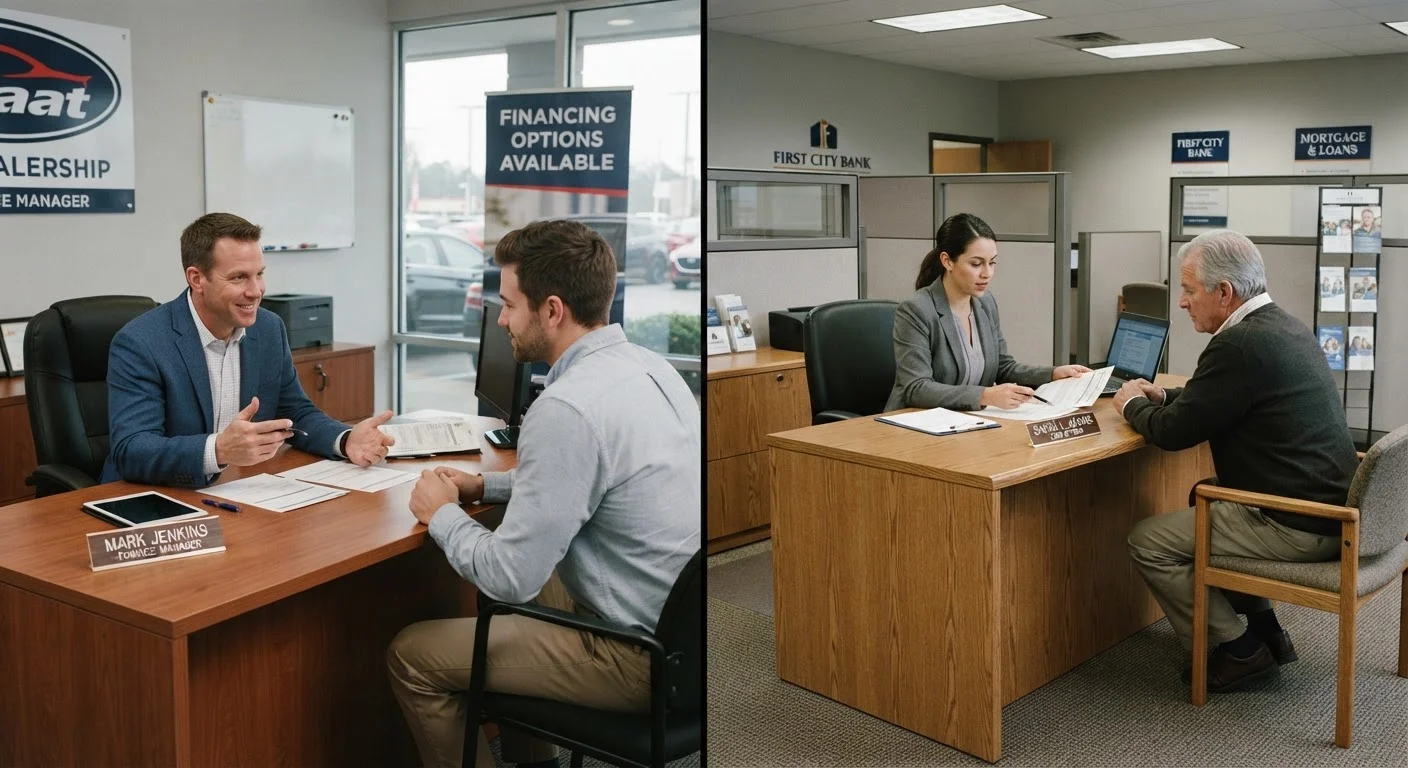
Photo credit: FaqsInsights.com | Stay Informed, Stay Ahead
In this article
Both paths have real advantages and drawbacks. Here's a balanced look at how each option typically plays out for buyers.
Key Takeaways
- Dealership financing offers convenience but may include rate markups that cost more over the loan's life.
- A pre-approved bank or credit union loan gives you a firm rate to compare against dealer offers.
- Having both options in hand is often the strongest negotiating position at a dealership.
- Your credit score significantly shapes the rates available from both sources.
- Manufacturer-backed dealer financing can sometimes offer rates below what banks will match.
One-stop convenience during purchase
Dealer financing is handled in the same visit as the sale, eliminating the need to arrange a loan separately before arriving.
Access to manufacturer promotional rates
Automakers periodically offer low or zero-percent APR financing on select models, exclusively through their captive lenders - rates outside lenders cannot replicate.
Multiple lender submissions simultaneously
Dealers submit your application to several lenders at once, which can surface offers you might not have found on your own.
May work with a wider credit range
Dealer lender networks sometimes include subprime lenders, giving buyers with lower credit scores more options than a single bank visit might yield.
Rate markups may increase total loan cost
Dealers can legally add a margin above the lender's approved rate and retain it as profit, a cost that isn't always transparent to the buyer.
Less rate transparency upfront
Without a comparison point, it's difficult to know whether the rate offered is competitive or inflated - making pre-approval elsewhere an important benchmark.
Focus on monthly payments can obscure total cost
F&I offices sometimes negotiate around monthly payment rather than total price or rate, which can lead buyers to accept longer loan terms and higher overall interest.
Add-on products can complicate the deal
The F&I process often includes pitches for extended warranties, GAP insurance, and other products that increase the financed amount if not declined explicitly.
Two Paths to the Same Loan
When you finance a car, someone is lending you money - but who that lender is, and on what terms, varies widely depending on how you arrange it. The two most common routes are financing through the dealership's finance-and-insurance (F&I) office, or arriving with a pre-approved loan from a bank or credit union.
Both approaches result in a monthly payment and an interest rate. The differences lie in transparency, convenience, and how much room you have to negotiate. Before diving into the trade-offs, it helps to understand how auto loan terms like APR and loan principal work so you can compare offers on equal footing.
Dealership Financing: The Pros and the Catches
Financing through a dealership is the path most buyers take simply because it's built into the purchase process. The dealer works with a network of lenders - banks, captive finance arms (the automaker's own lending division), and credit companies - and submits your application to multiple sources simultaneously.
One-stop convenience during purchase
Dealer financing is handled in the same visit as the sale, eliminating the need to arrange a loan separately before arriving.
Access to manufacturer promotional rates
Automakers periodically offer low or zero-percent APR financing on select models, exclusively through their captive lenders - rates outside lenders cannot replicate.
Multiple lender submissions simultaneously
Dealers submit your application to several lenders at once, which can surface offers you might not have found on your own.
May work with a wider credit range
Dealer lender networks sometimes include subprime lenders, giving buyers with lower credit scores more options than a single bank visit might yield.
The potential catch is a practice called rate markup. Lenders often allow dealers to add a margin above the rate the buyer actually qualifies for, and the dealer keeps that difference as profit. This markup is not always disclosed and can add hundreds or thousands of dollars in interest over the life of a loan.
Promotional rates - such as 0% or low-APR offers on new vehicles - are a genuine advantage of dealer financing that outside lenders cannot match. These are funded by the manufacturer and tied to specific models and credit tiers. If you qualify and the vehicle you want carries such an offer, dealership financing may clearly win on cost.
Rate markups may increase total loan cost
Dealers can legally add a margin above the lender's approved rate and retain it as profit, a cost that isn't always transparent to the buyer.
Less rate transparency upfront
Without a comparison point, it's difficult to know whether the rate offered is competitive or inflated - making pre-approval elsewhere an important benchmark.
Focus on monthly payments can obscure total cost
F&I offices sometimes negotiate around monthly payment rather than total price or rate, which can lead buyers to accept longer loan terms and higher overall interest.
Add-on products can complicate the deal
The F&I process often includes pitches for extended warranties, GAP insurance, and other products that increase the financed amount if not declined explicitly.
Bank and Credit Union Loans: Pre-Approval as a Tool
Getting pre-approved by a bank or credit union before you visit a dealer does several things at once. It tells you exactly what rate you qualify for, how much you can borrow, and - crucially - it converts your dealership visit from a financing conversation into a price negotiation.
~80%
Car buyers who finance at the dealership
Consumer Financial Protection Bureau research has consistently found that a large majority of financed vehicle purchases are arranged through dealership F&I offices rather than outside lenders.
0.5-1%+
Typical dealer rate markup range
Industry and regulatory analyses have documented that dealer interest rate markups commonly range from half a percentage point to over one percent above the lender's approved rate, with variation by credit tier.
Credit unions, in particular, are known for competitive auto loan rates and lower fees, partly because they operate as member-owned nonprofits. Online banks and community banks are also worth contacting. The main trade-off is time: you need to apply in advance, and each application may involve a hard credit inquiry. Applying to multiple lenders within a short window - typically 14 to 45 days depending on the scoring model - generally counts as a single inquiry for credit-scoring purposes.
One limitation of bank pre-approval is that it applies to your creditworthiness, not the specific vehicle. Some lenders restrict loan-to-value ratios or won't finance vehicles beyond a certain age or mileage, which matters more when buying used. This financing consideration is one of the real differences explored in our overview of how new and used vehicles differ.
Rate Shopping and Your Credit Score
When comparing loan offers, multiple hard inquiries from auto lenders within a short window are typically treated as a single inquiry by major credit scoring models - minimizing the impact on your score. The exact window varies by scoring model (commonly 14 to 45 days), so it's worth checking which model your lender uses. Applying to several lenders in quick succession is generally considered a sound strategy for finding a competitive rate.
Using Both Options Together
The most strategically sound approach for many buyers is to secure a pre-approved loan and remain open to dealership financing. Walk in with a bank offer in hand, share that rate with the F&I office, and ask if they can beat it. If the dealer can secure a lower rate through their lender network, you benefit. If not, you use your pre-approval.
This approach keeps the transaction focused on the vehicle's price rather than the monthly payment - a common dealership tactic is to shift the conversation to monthly payments, which can obscure total loan cost. Understanding the full picture of the car-buying process, from budgeting to signing paperwork, helps you anticipate these moments before they happen.
For buyers considering purchasing remotely, it's worth noting that online car purchases follow a different financing workflow and pre-approval from an outside lender is often the primary financing mechanism.
This article is for general informational purposes only and does not constitute personalized financial or legal advice. Readers should consult a qualified financial professional before making financing decisions.

Author
Cars & Driving Editorial Team
Cars & Driving Editorial Team is the collective byline for our editorial team and contributor network. Articles published under this byline or an editorial pen name are researched, written, and reviewed according to our editorial standards for clarity, consistency, and independence before publication.
View all articles →