
Free vs. Paid Online Courses: What the Price Tag Does and Doesn't Tell You
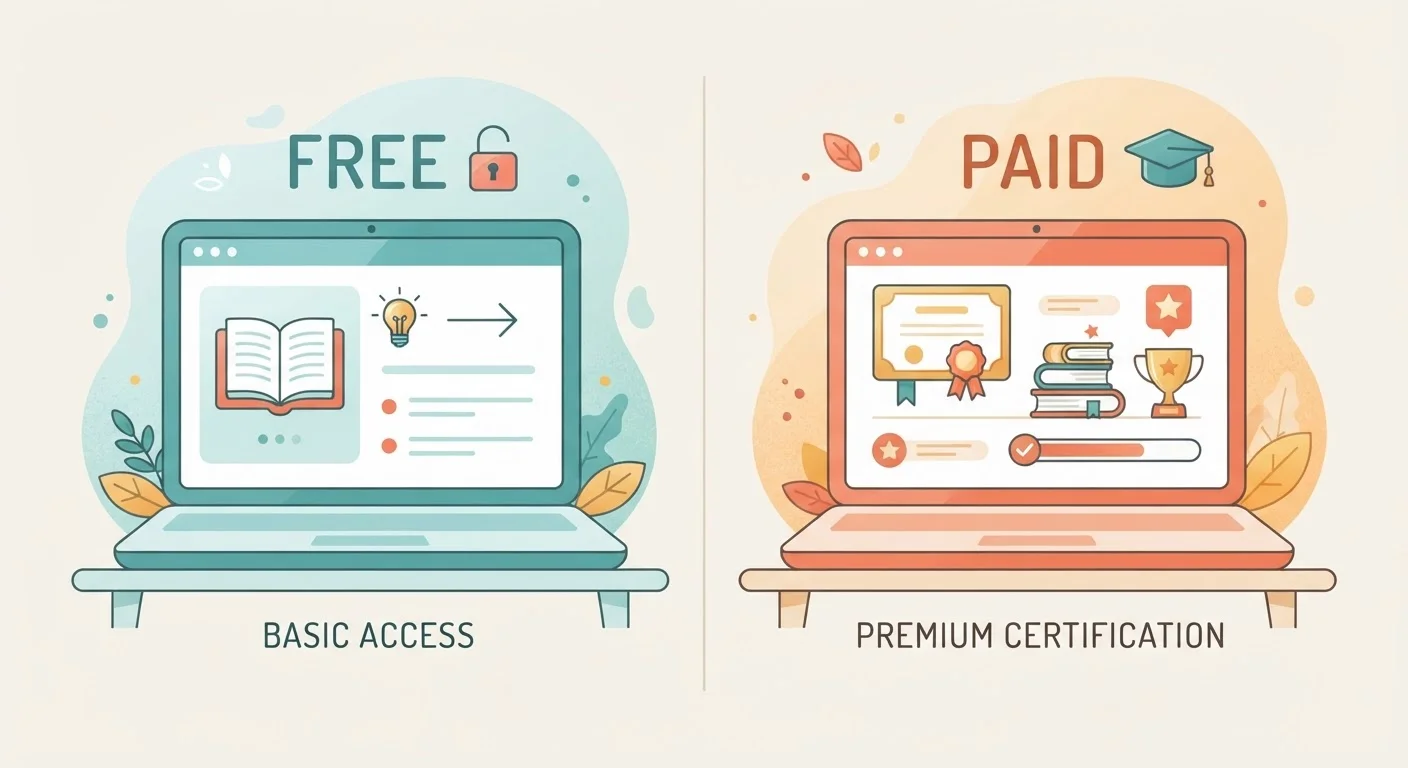
Photo credit: FaqsInsights.com | Stay Informed, Stay Ahead
In this article
Free courses exist in abundance, but paid options often promise more. Here's an honest look at what you gain and give up with each approach.
Key Takeaways
- Free courses can deliver genuine, high-quality learning - especially for exploration and foundational skills.
- Paid courses often provide structured accountability, instructor feedback, and recognized credentials.
- Cost alone is a poor proxy for course quality; curriculum depth and instructor credibility matter more.
- Your learning goal - exploration vs. career advancement - should drive the free-vs.-paid decision.
- Completion rates and learner support differ significantly between free and paid formats.
Zero financial risk to explore a new subject
Free courses allow learners to test interest in a topic without any monetary commitment, making them ideal for discovery and early-stage learning.
Access to university-level content at no cost
Many accredited institutions publish course materials openly, giving motivated learners access to rigorous content that was once only available to enrolled students.
Flexible, self-paced learning with no enrollment pressure
Most free courses impose no deadlines, allowing learners to fit study around work and personal commitments without penalty.
Ideal for supplementing knowledge you already have
Experienced learners can use free resources to fill specific knowledge gaps or stay current in a field without paying for content they largely already know.
Low completion rates without financial accountability
Without a financial stake, many learners disengage early. The ease of enrollment contributes to a pattern of starting courses that are never finished.
Limited or no instructor feedback on work
Free courses rarely include personalized feedback on assignments, which reduces the depth of learning and makes it harder to identify and correct mistakes.
Credentials often carry little professional weight
Completion certificates from free courses are frequently unverified and may not be recognized by employers or academic institutions as meaningful credentials.
Course quality and currency are inconsistent
Free offerings vary widely in rigor, accuracy, and how recently they were updated - learners must do additional vetting that paid platforms sometimes handle upfront.
What You're Actually Comparing
The phrase "free vs. paid" implies a simple binary, but the reality is messier. A free course from a well-resourced university's open courseware library and a free promotional module from a software company are both technically free - yet they're nothing alike in depth, rigor, or intent. Similarly, a $19 self-paced video series and a $2,000 cohort-based program are both paid - but they offer fundamentally different learning experiences.
Before weighing price, it helps to understand what you're actually evaluating. Key variables include curriculum depth, instructor qualifications, learner support, assessment quality, and whether a credential is attached. Price is one signal among many, and often a misleading one. For a broader framework on what to examine before enrolling, see what to evaluate before you enroll.
"Free" Doesn't Always Mean No Cost
Some platforms offer free course access but charge for graded assignments, certificates, or instructor interaction. Others use a freemium model where core content is available at no cost but meaningful features require a subscription. Always read the access terms carefully before assuming a free course includes everything you need to meet your learning goals.
The Real Advantages of Free Courses
Free courses have expanded dramatically in both number and quality over the past decade, largely due to the growth of MOOCs and open educational resources from accredited institutions. For a fuller picture of how MOOCs fit into modern education, the MOOCs explained guide is worth reading alongside this article.
Zero financial risk to explore a new subject
Free courses allow learners to test interest in a topic without any monetary commitment, making them ideal for discovery and early-stage learning.
Access to university-level content at no cost
Many accredited institutions publish course materials openly, giving motivated learners access to rigorous content that was once only available to enrolled students.
Flexible, self-paced learning with no enrollment pressure
Most free courses impose no deadlines, allowing learners to fit study around work and personal commitments without penalty.
Ideal for supplementing knowledge you already have
Experienced learners can use free resources to fill specific knowledge gaps or stay current in a field without paying for content they largely already know.
The most underappreciated advantage of free courses is their low-stakes nature. A learner can test an unfamiliar subject, discover it isn't the right fit, and move on without financial regret. This makes free options particularly well-suited to early-stage exploration before committing time and money to a longer program.
Where Free Courses Fall Short
Despite their accessibility, free courses consistently show lower completion rates than paid alternatives. Research on MOOC completion suggests that many learners enroll but disengage well before finishing - a pattern that reflects both the lack of financial commitment and limited structural accountability.
Low completion rates without financial accountability
Without a financial stake, many learners disengage early. The ease of enrollment contributes to a pattern of starting courses that are never finished.
Limited or no instructor feedback on work
Free courses rarely include personalized feedback on assignments, which reduces the depth of learning and makes it harder to identify and correct mistakes.
Credentials often carry little professional weight
Completion certificates from free courses are frequently unverified and may not be recognized by employers or academic institutions as meaningful credentials.
Course quality and currency are inconsistent
Free offerings vary widely in rigor, accuracy, and how recently they were updated - learners must do additional vetting that paid platforms sometimes handle upfront.
Free courses also tend to omit the feedback loops that deepen learning: graded projects reviewed by instructors, peer critique, or office-hours-style interaction. For learners who need external motivation or who are building skills they intend to use professionally, these gaps matter. If you're weighing how much structure you actually need, the comparison between structured courses and self-directed learning offers useful perspective.
What Paid Courses Add - and Don't Guarantee
Paying for a course introduces a financial stake that, for many learners, translates directly into follow-through. Beyond psychology, paid courses more commonly include human feedback, mentorship access, community cohorts, and credentials with verified weight in professional contexts. For a deeper look at how cohort-based and self-paced paid formats differ from each other, see cohort-based vs. self-paced courses.
~15%
Typical MOOC course completion rate
Research published in academic journals on open online learning has consistently found average completion rates for free MOOCs hovering around 15% or below.
2-4×
Higher completion in paid vs. free formats
Studies on online learning engagement suggest that financial commitment and structured accountability in paid programs are associated with meaningfully higher course completion.
That said, price does not guarantee quality. Some paid courses consist of outdated video recordings with minimal instructor involvement and a certificate that carries little professional recognition. The tuition charged tells you almost nothing about whether the curriculum is current, the instructor credible, or the credential meaningful to employers.
Making the Decision That Fits Your Situation
The most useful question isn't "Is this course free or paid?" but rather: What outcome do I need, and what level of support will get me there?
- Exploring a new topic: A free course is almost always sufficient and sensible.
- Building a demonstrable skill for employment: Look for paid options with real assessments, instructor feedback, and verifiable credentials.
- Supplementing formal education: Free materials from reputable institutions can add significant value at no cost.
- Career transition or professional development: A paid program with structured accountability and industry-recognized outcomes may justify the investment.
If this is your first time navigating online learning altogether, the ground-up introduction to taking your first online course can help you approach the process with more confidence. And for the complete picture of online education - formats, costs, credentials, and limitations - the complete picture of online learning covers the full landscape in one place.

Author
Learning & Education Editorial Team
Learning & Education Editorial Team is the collective byline for our editorial team and contributor network. Articles published under this byline or an editorial pen name are researched, written, and reviewed according to our editorial standards for clarity, consistency, and independence before publication.
View all articles →