
Envelope Budgeting in a Digital World
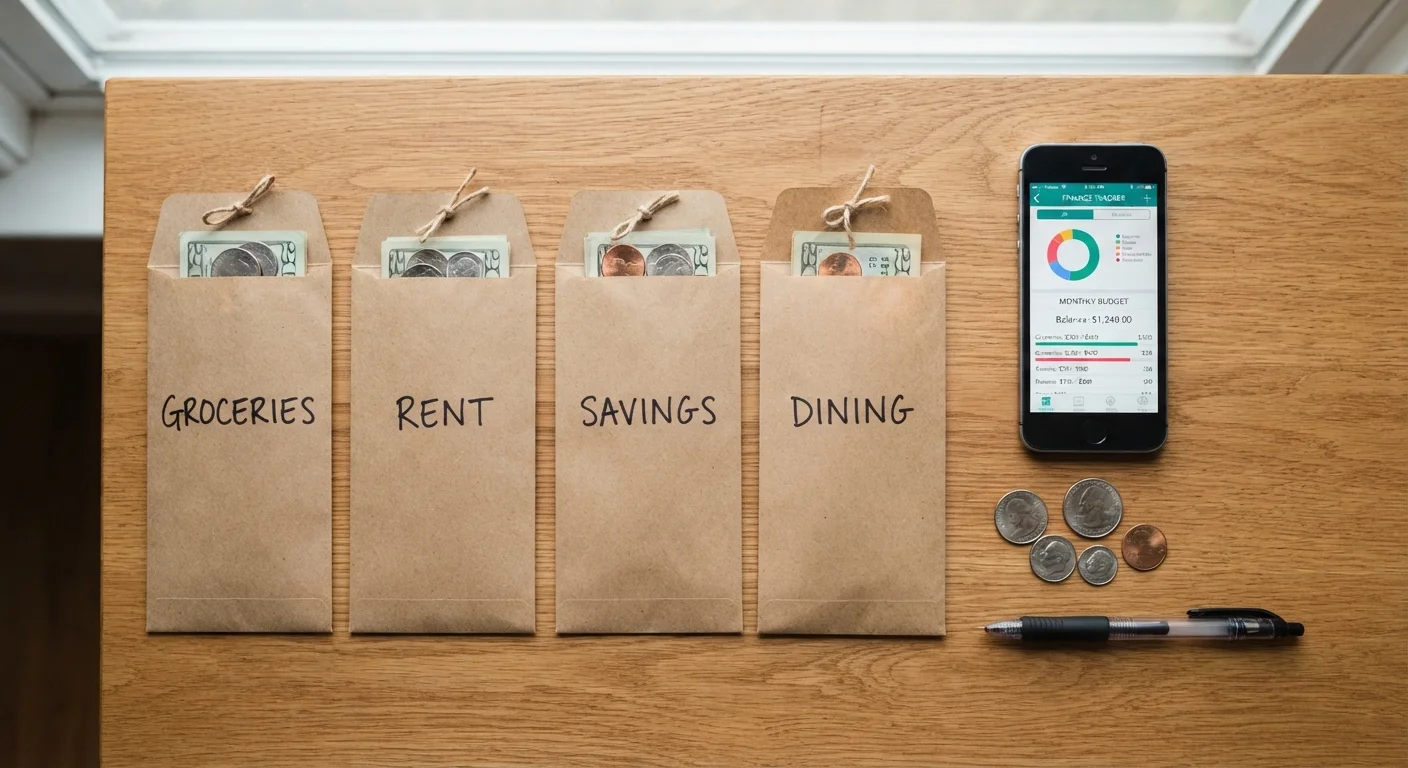
Photo credit: FaqsInsights.com | Stay Informed, Stay Ahead
In this article
The classic cash-envelope method has gone paperless. Explore how the core principle works, its strengths, and its real limitations in modern life.
Key Takeaways
- Envelope budgeting assigns a fixed spending limit to each spending category before the month begins.
- Digital apps now replicate the method without requiring physical cash withdrawals.
- The system works best for variable discretionary spending like groceries, dining, and entertainment.
- Its rigid structure can be a strength for overspenders but a frustration for irregular earners.
- Pairing it with a broader budgeting foundation increases long-term success.
Creates hard, visible spending limits per category
Seeing a balance approach zero in a specific envelope provides a clear, immediate signal to slow down - a cue that abstract credit card statements rarely deliver.
Reduces unconscious overspending in variable categories
Groceries, dining, and entertainment are common budget-busters precisely because they lack natural limits. Envelopes impose those limits by design.
Psychologically reinforces the value of money
Whether using cash or a digital tracker, the act of assigning dollars to specific purposes before spending them encourages more deliberate financial decisions.
Flexible enough to adapt to individual priorities
Users define their own categories, so the system reflects actual spending patterns rather than forcing people into generic buckets that may not match their lives.
Works as a standalone method or within a broader plan
Envelope budgeting can complement zero-based budgeting or any other framework, functioning as the execution layer for discretionary spending control.
Requires consistent, ongoing manual effort
Even digital apps demand regular transaction review and recategorization. Users who fall behind by even a week often find the system has lost its real-time accountability value.
Cash-only version is impractical for digital payments
Online subscriptions, automatic bill pay, and contactless transactions don't naturally fit a cash-envelope workflow, requiring workarounds that add friction.
Rigid structure struggles with irregular income
Funding set envelope amounts at the start of a month assumes predictable income - a condition that freelancers, seasonal workers, and commission earners may not reliably meet.
Doesn't inherently address savings or debt paydown
The system focuses on spending allocation; without deliberately creating envelopes for savings goals and debt payments, those priorities can be overlooked.
Category overflow requires manual rebalancing
When an unexpected expense exhausts one envelope, money must be consciously moved from another - a process that requires discipline and can feel discouraging early on.
What Envelope Budgeting Actually Is
The envelope method is a cash-based budgeting system with straightforward logic: at the start of each month, you divide your take-home pay into physical envelopes, each labeled for a specific spending category - groceries, gas, dining out, clothing, and so on. When an envelope is empty, spending in that category stops until the next funding cycle.
Popularized in personal finance circles for decades, the system works because it makes budget limits physical and finite. You cannot accidentally overspend on groceries if the envelope only holds $300 in cash.
Today, most practitioners skip the paper entirely. Digital envelope apps simulate the same mechanic by letting users create virtual envelopes (often called "categories" or "buckets") funded from a connected bank balance. Transactions are logged against each envelope in real time. If you're new to building a spending plan from scratch, start with the fundamentals before layering on a specific method.
Advantages of the Envelope System
Creates hard, visible spending limits per category
Seeing a balance approach zero in a specific envelope provides a clear, immediate signal to slow down - a cue that abstract credit card statements rarely deliver.
Reduces unconscious overspending in variable categories
Groceries, dining, and entertainment are common budget-busters precisely because they lack natural limits. Envelopes impose those limits by design.
Psychologically reinforces the value of money
Whether using cash or a digital tracker, the act of assigning dollars to specific purposes before spending them encourages more deliberate financial decisions.
Flexible enough to adapt to individual priorities
Users define their own categories, so the system reflects actual spending patterns rather than forcing people into generic buckets that may not match their lives.
Works as a standalone method or within a broader plan
Envelope budgeting can complement zero-based budgeting or any other framework, functioning as the execution layer for discretionary spending control.
The system's greatest strength is behavioral. Behavioral economics research consistently shows that people spend more freely with cards than with cash - a phenomenon sometimes called the "pain of paying." Envelope budgeting reintroduces that friction, even in its digital form, by forcing users to consciously log and confront each transaction.
For households tackling overspending in specific categories, these hard limits function as a built-in accountability mechanism. When the dining envelope hits zero on the 20th of the month, the data is impossible to ignore.
Drawbacks Worth Considering
Requires consistent, ongoing manual effort
Even digital apps demand regular transaction review and recategorization. Users who fall behind by even a week often find the system has lost its real-time accountability value.
Cash-only version is impractical for digital payments
Online subscriptions, automatic bill pay, and contactless transactions don't naturally fit a cash-envelope workflow, requiring workarounds that add friction.
Rigid structure struggles with irregular income
Funding set envelope amounts at the start of a month assumes predictable income - a condition that freelancers, seasonal workers, and commission earners may not reliably meet.
Doesn't inherently address savings or debt paydown
The system focuses on spending allocation; without deliberately creating envelopes for savings goals and debt payments, those priorities can be overlooked.
Category overflow requires manual rebalancing
When an unexpected expense exhausts one envelope, money must be consciously moved from another - a process that requires discipline and can feel discouraging early on.
The envelope method's rigidity, its biggest asset, can also be its primary liability. Life does not respect budget categories. A car repair, a medical co-pay, or a utility spike can empty one envelope while others sit untouched, requiring manual rebalancing that takes effort and discipline to maintain consistently.
Gig workers, freelancers, or anyone with irregular income may find it particularly difficult to fund envelopes at the start of a month when income is unpredictable. For a side-by-side look at how envelope-style thinking compares with other frameworks, see our overview of zero-based and percentage-based budgeting.
Making It Work in a Digital-First Life
Most everyday transactions now happen via debit cards, credit cards, or mobile payments - formats that don't naturally align with cash-only envelopes. Digital envelope apps bridge this gap by syncing with bank accounts and automating transaction categorization, but they still require the user to review and approve entries regularly.
Credit Cards and Envelope Budgeting
Using a rewards credit card doesn't automatically conflict with the envelope method. Some practitioners charge purchases to a card, then immediately deduct the amount from the corresponding digital envelope - treating the card purely as a payment mechanism. This approach preserves the spending-limit discipline while still capturing any card benefits. However, it only works reliably if the card balance is paid in full each month to avoid interest charges that would undermine the budget entirely.
For those who prefer not to rely on a dedicated app, a simple spreadsheet can replicate the logic: columns for each category, rows for each transaction, and a running balance that decreases with every entry. Comparing budgeting formats can help you choose the right tool for your habits.
One practical tip: reserve the envelope method for discretionary, variable spending. Fixed expenses like rent, insurance premiums, and loan payments are better tracked separately, since their amounts rarely change and benefit less from envelope-style controls. If you want a concrete monthly structure to wrap around this approach, setting up a monthly budget provides a step-by-step framework.
36%
Americans with a detailed household budget
A Gallup survey found that fewer than four in ten U.S. adults report maintaining a detailed monthly budget, suggesting most households lack a formal spending structure.
~18%
More spent with cards vs. cash
Multiple consumer behavior studies have found that people tend to spend meaningfully more when paying with cards compared to cash, supporting the core premise of cash-envelope systems.

Author
Money & Finance Editorial Team
Money & Finance Editorial Team is the collective byline for our editorial team and contributor network. Articles published under this byline or an editorial pen name are researched, written, and reviewed according to our editorial standards for clarity, consistency, and independence before publication.
View all articles →