
Paper Ledger vs. Spreadsheet vs. Budgeting App: Weighing Your Options
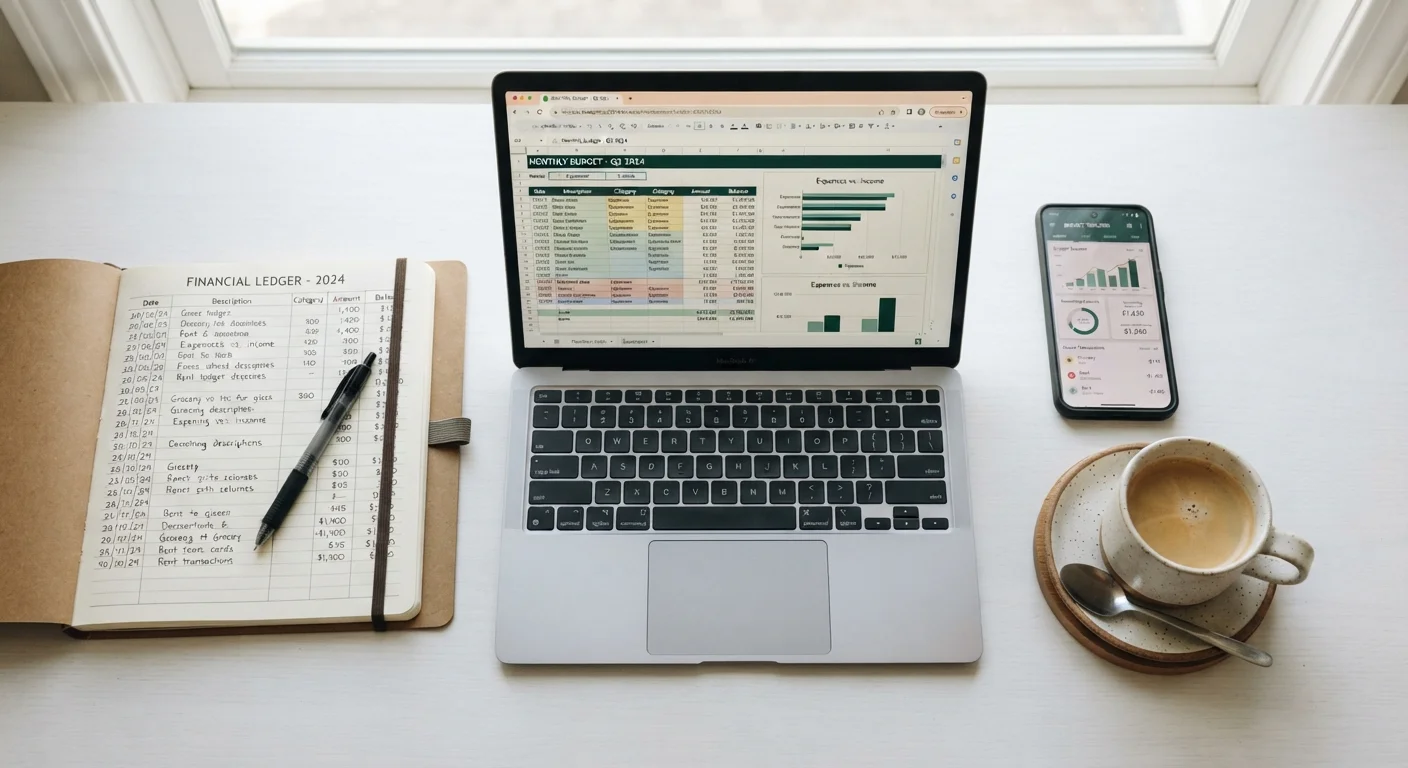
Photo credit: FaqsInsights.com | Stay Informed, Stay Ahead
In this article
Each budgeting format has real trade-offs in accuracy, effort, and flexibility. Here's an honest look at how they compare for different types of users.
Key Takeaways
- Paper ledgers build strong money habits through deliberate, manual tracking but require consistent effort.
- Spreadsheets offer full customization and powerful calculations but demand comfort with formulas and setup time.
- Budgeting apps automate much of the tracking process but involve data-sharing trade-offs and subscription costs.
- No single format suits every person - the right choice depends on your habits, tech comfort, and privacy priorities.
- Switching formats mid-year is possible; the best budget tool is one you will actually use consistently.
Why the Format Actually Matters
A budget is only as good as your ability to maintain it. Before choosing a format, it helps to understand what each one demands from you - in time, attention, and technical skill - and what each one gives back in clarity and control. If you're new to budgeting entirely, see our introduction to personal budgeting for a foundation before diving into format comparisons.
The three most common approaches - paper ledgers, spreadsheets, and dedicated budgeting apps - represent a spectrum from fully manual to largely automated. Each has genuine strengths that match specific user needs and real limitations that can derail people who aren't suited to that style.
| Paper Ledger | Spreadsheet | Budgeting App | |
|---|---|---|---|
| Setup effort | Minimal - just start writing | Moderate - build or adapt a template | Low - link accounts and go |
| Ongoing effort | High - fully manual entry | Medium - manual or CSV import | Low - mostly automated |
| Cost | Near zero | Free to low (software cost) | Varies; many charge monthly fee |
| Customization | Unlimited but unstructured | Very high with formula skill | Limited to app's framework |
| Data privacy | Maximum - no digital exposure | High - local or cloud storage | Lower - bank credentials shared |
| Error risk | Math errors possible | Formula errors if misconfigured | Miscategorization by algorithm |
| Best for irregular income | Workable but tedious | Excellent - fully flexible | Varies by app design |
Paper Ledger: The Case for Going Analog
Writing every transaction by hand sounds tedious, but research in cognitive psychology consistently suggests that the act of writing reinforces memory and attention - a dynamic that carries over to financial awareness. When you record a $47 grocery run with a pen, you process it deliberately rather than letting it scroll past on a screen.
Strengths: Zero setup cost, no subscription, no data-privacy risk, and no reliance on technology. A simple composition notebook works. Paper ledgers also function well for people whose spending is relatively simple - a fixed income, a small number of recurring bills, and a handful of variable categories.
Limitations: Totaling columns, spotting trends over time, and catching math errors all require manual effort. There is no automatic sync with your bank, no spending alerts, and no year-over-year chart. If you miss several days of entries, catching up becomes a chore that many people skip entirely.
Start Simple, Then Add Complexity
If you've struggled to maintain a budget in the past, begin with the lowest-friction option you'll actually use - even a basic notebook. Once the habit of reviewing your spending is established, you can migrate to a more powerful format. Switching tools mid-year is entirely feasible; just carry your category totals forward so you don't lose continuity.
Paper works best as a daily habit rather than a weekly catch-up session. Keeping your ledger visible - on a desk or kitchen counter - reduces the likelihood of skipping entries.
Spreadsheets: Power and Flexibility, With a Learning Curve
A well-built spreadsheet is arguably the most flexible budgeting tool available. Formulas can automatically calculate totals, flag overspending in red, and generate monthly trend charts - all without a subscription fee. Free templates from financial education sites can get you started without building from scratch.
Strengths: Complete ownership of your data, deep customization, the ability to model scenarios (e.g., what if I cut dining out by $100?), and compatibility with any income structure, including irregular or freelance income. For people comfortable with tools like Google Sheets or Excel, setup is a one-time investment that pays dividends for years. The step-by-step monthly budget guide pairs well with a spreadsheet approach.
Limitations: You still enter transactions manually unless you import bank CSV files. Formulas can break if you're not careful. And for users who find spreadsheets intimidating, the setup barrier alone may prevent adoption.
~32%
US adults who follow a detailed budget
According to Gallup polling, roughly one in three American adults reports maintaining a detailed household budget, suggesting significant room for adoption of any format.
1 in 5
Adults who use a budgeting app regularly
Various consumer finance surveys suggest roughly 20% of US adults use a digital budgeting tool consistently, though adoption has been growing steadily.
Budgeting Apps: Automation at a Cost
Dedicated budgeting apps - whether zero-based, category-envelope, or transaction-tracking in style - connect directly to your bank and credit card accounts, pulling in transactions automatically. This removes the largest friction point for most people: the daily or weekly data entry grind.
Strengths: Real-time spending visibility, automated categorization, alerts when you're approaching a category limit, and often rich reporting dashboards. Many apps also support collaborative budgeting for households. If you're comparing budgeting philosophies that apps often reflect, our zero-based vs. percentage-based budgeting comparison breaks down the two dominant approaches.
Limitations: Most full-featured apps require a monthly or annual subscription. Connecting your bank credentials to a third-party service involves real data-privacy considerations worth understanding before signing up. Automated categorization is also imperfect - miscategorized transactions can quietly distort your picture of spending unless you review them regularly.
Automation Can Create a False Sense of Control
Budgeting apps sync your accounts and categorize spending automatically, which is genuinely useful - but it can also lull you into passive monitoring rather than active decision-making. Plan to review your app's transaction feed at least weekly to catch miscategorizations and stay genuinely engaged with where your money is going. A dashboard you glance at without reflecting on the numbers is not a budget - it's a spending report.
Some users also find that the reduced friction of apps makes it easier to stay passive - checking a dashboard rather than actively engaging with their spending decisions. For the envelope-style variant of this approach, see envelope budgeting in a digital world.
Choosing the Right Tool for Your Situation
There is no universally correct format. A few honest questions can help narrow it down:
- How simple is your financial life? Fewer income streams and spending categories favor paper or a basic spreadsheet.
- How comfortable are you with technology? Spreadsheet formulas and app interfaces have learning curves; paper has almost none.
- How important is data privacy to you? Paper and spreadsheets keep your financial data entirely under your control.
- Do you need automation to stay consistent? If manual entry has caused you to abandon budgets before, an app's automatic sync may be the feature that finally makes budgeting stick.
Many people also combine approaches - using an app for real-time tracking and a spreadsheet for monthly planning and review. Once you've chosen a format and built a routine, the monthly budget review checklist can help you assess what's working at the end of each month.
This article provides general financial education and is not personalized financial advice. Consider consulting a qualified financial professional for guidance specific to your situation.

Author
Money & Finance Editorial Team
Money & Finance Editorial Team is the collective byline for our editorial team and contributor network. Articles published under this byline or an editorial pen name are researched, written, and reviewed according to our editorial standards for clarity, consistency, and independence before publication.
View all articles →