
Clicker Training vs. Verbal Cues: Which Works Better for Dogs?
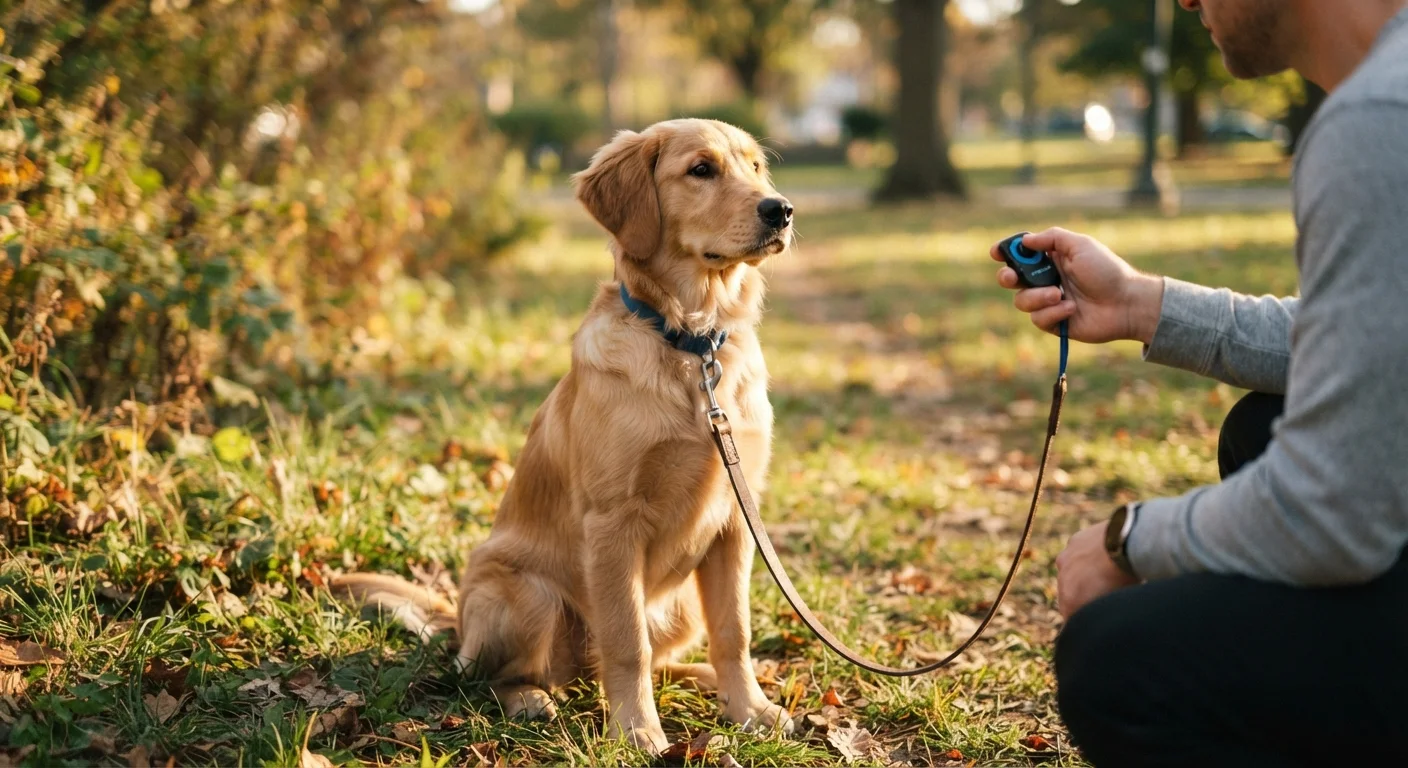
Photo credit: FaqsInsights.com | Stay Informed, Stay Ahead
In this article
Both clicker training and verbal cues have merit. See how they differ in practice so you can choose the right method for your dog's learning style.
Key Takeaways
- Clicker training uses a distinct sound to mark the exact moment a dog performs the desired behavior.
- Verbal cues are more convenient but can be harder to deliver with perfect consistency.
- Both methods rely on positive reinforcement - the marker itself means nothing without a reward following it.
- Many trainers combine both approaches, using a clicker to teach new behaviors and verbal cues to maintain them.
- A dog's individual temperament, hearing, and learning history can influence which method clicks best.
How Each Method Works
Both clicker training and verbal cues are marker-based training methods - tools used to communicate to a dog the precise moment a behavior earns a reward. Understanding what each marker actually does clarifies why they differ in practice.
Clicker training uses a small handheld device that produces a short, consistent clicking sound. The click itself is neutral and emotionless - it has no other meaning in a dog's life outside of training. Through repeated pairing with treats, the click becomes what behaviorists call a conditioned reinforcer: the sound predicts something good is coming. Because the click is always identical, it eliminates the subtle variation that creeps into a human voice.
Verbal cues (sometimes called verbal markers or command words) accomplish the same communicative goal using spoken language - a word like "yes," "good," or a specific command such as "sit." The advantage is immediacy: your voice is always with you. The challenge is consistency. Human speech naturally changes with mood, volume, and phrasing. A tired, distracted, or excited owner may say "yes" in ways that sound measurably different to a dog's sensitive ears.
Crucially, neither marker works in isolation. As explained in our guide to positive reinforcement, the marker only signals that a reward is on its way - remove the reward and the marker loses its meaning entirely.
| Criterion | Clicker Training | Verbal Cues |
|---|---|---|
| Timing precision | Very high - mechanical click is instantaneous | Moderate - depends on speaker's speed |
| Consistency | Uniform; unaffected by emotion or tone | Variable; voice changes with mood and context |
| Equipment required | Yes - clicker must be carried | None - voice always available |
| Learning curve for handler | Moderate - managing clicker + leash + treats | Lower - one fewer tool to coordinate |
| Suitability for noise-sensitive dogs | May cause initial startle | Gentler; tone can be adjusted |
| Effectiveness for complex behaviors | High - precise marking aids shaping | Good - sufficient with skilled handler |
| Long-term everyday use | Typically phased out as behavior becomes reliable | Integrates naturally into daily communication |
Timing, Consistency, and Learning Speed
The single biggest variable in any marker-based training is timing. Research in animal learning suggests that a marker delivered within roughly one to two seconds of the desired behavior is far more informative to a dog than a delayed one. The clicker's mechanical speed gives it a measurable edge here - a trained thumb can click faster than a human can form a word.
That said, timing is a learnable skill regardless of which method you use. Many handlers who train extensively with verbal markers develop timing just as sharp as clicker users. The gap often matters most early on, when dogs are still building their association between marker and reward.
~1-2 sec
Window for effective behavior marking
Animal learning research generally indicates that a marker delivered within one to two seconds of a behavior is most informative to the learner.
2-in-1
Roles a clicker serves in training
The clicker functions as both an event marker (pinpointing the correct behavior) and a conditioned reinforcer (predicting an incoming reward).
Consistency is the second factor. Because the clicker sound never wavers - it doesn't get softer when you're tired or sharper when you're frustrated - dogs receive a stable signal. Verbal markers, by contrast, can carry emotional tone. Dogs are highly attuned to human vocal patterns, and an excited "YES!" during a new trick may communicate something different than a flat "yes" delivered at the vet's office.
If your dog frequently tunes out cues altogether, the issue may be less about the marker type and more about the training environment itself - our article on why dogs ignore commands unpacks those common patterns.
Practical Considerations for Real-Life Use
Training doesn't happen only in a quiet backyard. The method you choose needs to fit your daily life, your dog's temperament, and the situations you most often encounter.
Equipment and convenience: A clicker requires you to have it on hand. In multi-dog households, it can also inadvertently mark a different dog's behavior if both are present. A verbal marker is always available and is inherently directed by voice toward a specific animal.
Transitioning from clicker to verbal: Many trainers use what's sometimes called a "fade" approach - start with the clicker's precision to teach new behaviors, then layer in a verbal cue once the behavior is reliable, and gradually phase out the click. This hybrid approach appears frequently in both competitive dog sports and everyday companion training.
Dogs with hearing differences: For dogs with partial or full hearing loss, neither a clicker nor a spoken word may be the primary marker. A visual marker - such as a thumbs-up or a small flashlight pulse - can serve the same conditioned reinforcer role.
Temperament: Some dogs are noise-sensitive and may flinch at the clicker's sharp sound, at least initially. A softer clicker or a verbal marker is often a more comfortable starting point for anxious dogs. Building your dog's broader skill set also matters - see our overview of underrated everyday skills for context on how markers support more than just sit and stay.
Combining Both Methods Is Common Practice
Using a clicker to teach a new behavior and then transitioning to a verbal cue once the dog is reliable is a widely used hybrid strategy. This approach lets you benefit from the clicker's precision during the learning phase while keeping a verbal cue available for everyday real-world use. Neither method has to be permanent or exclusive - flexibility is an asset in training.
This article is for general educational purposes. For dogs with significant anxiety, reactivity, or behavioral challenges, consult a certified professional trainer or veterinary behaviorist for individualized guidance.

Author
Pets & Animals Editorial Team
Pets & Animals Editorial Team is the collective byline for our editorial team and contributor network. Articles published under this byline or an editorial pen name are researched, written, and reviewed according to our editorial standards for clarity, consistency, and independence before publication.
View all articles →