
Drowsy Driving vs. Distracted Driving: Two Different Dangers, Same Deadly Outcome
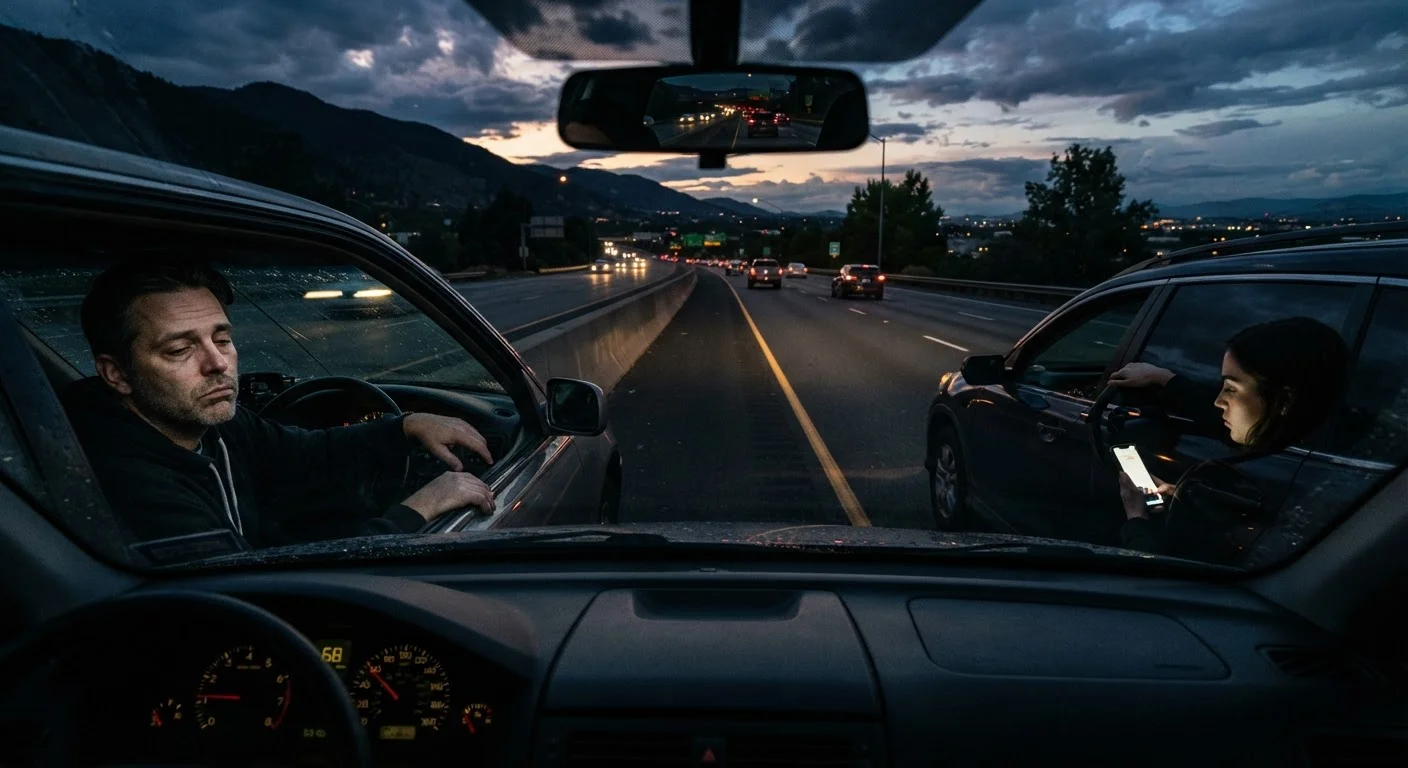
Photo credit: FaqsInsights.com | Stay Informed, Stay Ahead
In this article
Both impair reaction time and judgment, but they work differently and call for different countermeasures. Here's how to tell them apart and address each.
Key Takeaways
- Drowsy driving impairs reaction time similarly to alcohol; distracted driving removes attention from the road entirely.
- Microsleep episodes during drowsy driving can last up to 30 seconds - covering significant distance with no awareness.
- Cognitive distraction from hands-free calls is nearly as dangerous as holding a phone while driving.
- Neither condition is fully reversible mid-trip by simple tricks like opening a window or turning up the radio.
- Scheduling rest breaks and eliminating in-vehicle distractions before starting are the most reliable countermeasures.
How Each Impairment Actually Works
Drowsy driving and distracted driving both degrade your ability to respond to hazards - but they do so through entirely different physiological mechanisms. Understanding the difference matters because the countermeasures for each are not interchangeable.
Drowsy driving is a systemic impairment. Sleep deprivation slows neural processing across the brain, degrading reaction time, judgment, and situational awareness simultaneously. Most dangerously, it can produce microsleep - involuntary sleep episodes lasting two to thirty seconds. At 60 mph, a 10-second microsleep means traveling roughly 880 feet with no conscious input whatsoever. The driver's eyes may be open. They will have no memory of those seconds.
Distracted driving works differently: it diverts one or more of the three cognitive resources required for safe driving - visual attention (eyes off the road), manual control (hands off the wheel), or cognitive engagement (mind off the task). Texting is the most studied example because it engages all three simultaneously. But research consistently shows that even hands-free phone conversations impose significant cognitive load, reducing a driver's field of awareness to a narrow tunnel.
The key distinction: a drowsy driver is degraded but present; a distracted driver may be physiologically alert but mentally or visually absent during the critical seconds before a crash.
| Criterion | Drowsy Driving | Distracted Driving |
|---|---|---|
| Primary mechanism | Systemic brain impairment from sleep deprivation | Diversion of visual, manual, or cognitive attention |
| Most dangerous manifestation | Microsleep episodes with no awareness | Full attention removed during critical seconds |
| Driver self-awareness | Often unaware of severity until too late | Usually aware, but underestimates impact |
| Highest-risk scenarios | Late-night/early-morning highway driving | Urban commuting, stop-and-go traffic |
| Effective countermeasure | Rest, sleep scheduling, planned stops | Eliminating devices and in-car interactions |
| Common misconception | Caffeine or windows fully restore alertness | Hands-free calls are safe |
Warning Signs and Self-Assessment
One reason both conditions are so dangerous is that drivers consistently underestimate how impaired they are. Neither drowsiness nor distraction triggers a clear internal alarm.
Signs of dangerous drowsiness include difficulty keeping your eyes focused, repeated yawning, drifting across lane lines, missing exits you know well, and an inability to recall the last few miles of road. If you notice any of these, they indicate impairment that is already affecting your driving - not an early warning.
Distraction is often self-inflicted, meaning drivers know they're engaging with a phone, a passenger, or an in-dash screen. The problem is underestimating how much capacity that engagement consumes. Studies published by the AAA Foundation for Traffic Safety found that even after ending a phone call, cognitive distraction can persist for up to 27 seconds - meaning a driver who hangs up at a stop light may still be impaired through the entire intersection.
~100,000
Police-reported drowsy driving crashes annually (US)
According to the National Highway Traffic Safety Administration (NHTSA), drowsy driving is a factor in tens of thousands of crashes each year, though experts believe the true number is substantially higher due to underreporting.
27 seconds
Cognitive distraction lingering after ending a call
AAA Foundation for Traffic Safety research found that cognitive distraction persists for up to 27 seconds after completing a hands-free call - covering a significant distance at typical speeds.
3x
Increased crash risk when visually distracted
The NHTSA and Virginia Tech Transportation Institute have found that visual distraction - eyes off the road - is associated with crash risk roughly three times that of an undistracted driver.
For new drivers especially, both risks are compounded by limited experience. Building foundational defensive habits early - including strict no-phone policies and honest self-assessment of fatigue - is one of the most protective steps a beginning driver can take.
Practical Countermeasures for Each
Because the mechanisms differ, so do the solutions.
For drowsy driving: The only reliable countermeasure is sleep. Caffeine can provide 20-30 minutes of marginal alertness, but it does not restore reaction time or eliminate microsleep risk. If you feel drowsy while driving, pulling over and taking a 20-minute rest is the appropriate response. Planning drives to avoid the body's natural low-alertness windows - roughly 2-5 a.m. and 1-3 p.m. - reduces risk significantly. Night driving compounds drowsiness by reducing visual stimulation and triggering melatonin, making late-night highway drives particularly high-risk.
For distracted driving: The most effective countermeasure is elimination, not management. Placing your phone in Do Not Disturb mode, using a storage compartment rather than a cupholder or seat, and pre-setting navigation and music before moving all remove the temptation during travel. When passengers or in-vehicle systems compete for attention, briefly pausing the conversation or interaction at demanding intersections is a habit experienced, crash-free drivers use consistently.
Neither Risk Is Exclusive to Certain Drivers
Drowsy and distracted driving affect drivers across all age groups, experience levels, and trip types. While teen drivers face elevated distraction risk and shift workers face elevated drowsiness risk, both hazards are documented in everyday commuters and experienced long-haul drivers alike. Assuming familiarity or experience provides protection is itself a risk factor. Graduated licensing research reflects this - restrictions on night driving and passengers exist precisely because these compound known impairments.
Both risks increase with familiarity. Drivers are statistically more likely to engage in distracted behavior and to push through fatigue on routes they know well - precisely because the routine feel of a familiar road lowers perceived risk. That perception is not accurate.

Author
Cars & Driving Editorial Team
Cars & Driving Editorial Team is the collective byline for our editorial team and contributor network. Articles published under this byline or an editorial pen name are researched, written, and reviewed according to our editorial standards for clarity, consistency, and independence before publication.
View all articles →