
Night Driving and Your Eyes: What Happens to Vision After Dark
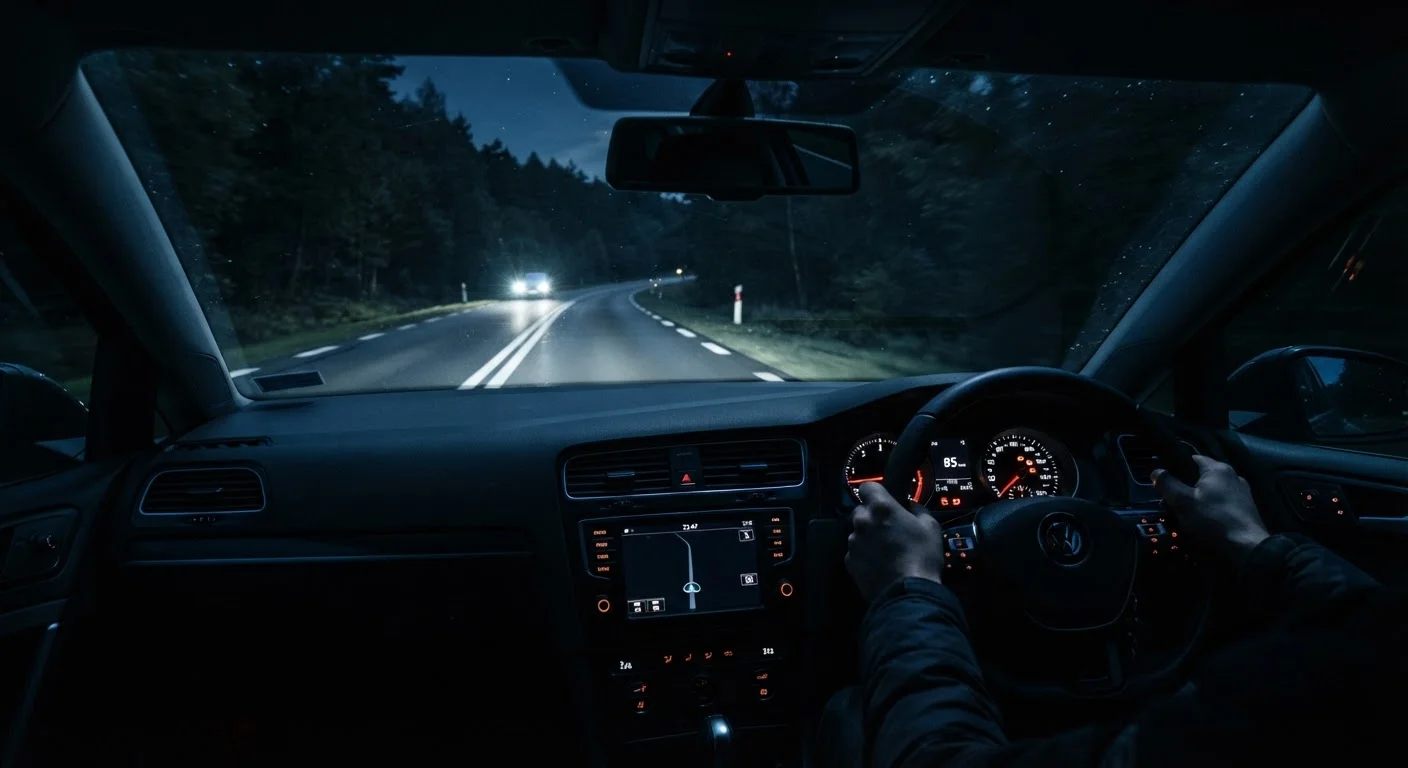
Photo credit: FaqsInsights.com | Stay Informed, Stay Ahead
In this article
Darkness, glare, and slower pupil response all affect how well you see at night. Learn what's happening physiologically and how to compensate.
Key Takeaways
- Your eyes take up to 30 minutes to fully adapt to darkness, leaving you temporarily vulnerable when transitioning from lit to unlit roads.
- Rod cells, which handle low-light vision, cannot detect color or fine detail the way cone cells can in daylight.
- Glare from oncoming headlights temporarily suppresses night vision and requires recovery time.
- Older drivers experience a more pronounced decline in night vision due to slower pupil response and lens changes.
- Reducing speed at night gives your eyes more time to process the limited visual information available.
- Dirty windshields and dim headlights worsen the effects of glare and reduced contrast after dark.
What Your Eyes Are Actually Doing After Dark
When ambient light drops, your visual system undergoes a series of rapid changes. The pupils dilate to allow more light onto the retina, and the eye begins shifting its primary reliance from cone cells - concentrated in the central retina and responsible for color and fine detail - to rod cells, which are more light-sensitive but cannot distinguish color or sharp edges.
This shift is called dark adaptation. The early phase happens quickly, but achieving full rod-dominant vision takes 20 to 30 minutes. That delay matters: if you move abruptly from a brightly lit parking lot or gas station onto a dark rural highway, your visual system is still catching up. During that window, you're seeing considerably less than you will be in half an hour.
Rod cells are also absent from the very center of your visual field (the fovea), which is why faint objects - such as a deer at the edge of your headlights - can sometimes be seen more clearly using peripheral vision rather than looking directly at them. This counterintuitive technique is worth knowing.
Peripheral Vision Works Differently at Night
Because rod cells are distributed across the peripheral retina rather than the center, low-light objects are sometimes easier to detect when you don't look directly at them. Trained pilots use a technique called "off-center viewing" for this reason. While it requires practice, being aware that your peripheral field is more light-sensitive at night can help you notice movement at the edges of your headlights more reliably.
Glare, Contrast Loss, and the Real Risks They Create
Two of the most significant visual challenges at night are glare and reduced contrast. Glare occurs when a bright light source - most commonly oncoming headlights - overwhelms the visual system, temporarily suppressing your adapted night vision. Recovery after a glare event takes several seconds, during which your ability to detect hazards is measurably diminished.
Contrast loss is subtler but equally important. During daylight, your visual system uses color difference and fine detail to distinguish objects from their surroundings. At night, you lose most of that. A pedestrian wearing dark clothing against a dark background may simply not register until dangerously close - not because your headlights failed to illuminate them, but because your eye-brain system lacks the contrast cues to detect them promptly.
As noted by traffic safety researchers, a dirty or scratched windshield dramatically worsens glare by scattering light in multiple directions. Keeping glass clean - inside and out - is one of the simplest and most overlooked improvements a driver can make for night safety. This connects directly to the kinds of habits that experienced drivers rely on quietly to reduce risk across conditions.
~50%
Of traffic fatalities occur at night
The National Safety Council estimates that roughly half of all traffic deaths happen in the dark, despite significantly lower nighttime traffic volume.
30 min
Time for full dark adaptation
Vision researchers consistently document that complete rod-dominant dark adaptation takes up to 30 minutes after transitioning from bright conditions.
3-7 sec
Glare recovery time after oncoming headlights
Studies on driver glare sensitivity suggest recovery times of several seconds following exposure to bright oncoming lights, during which hazard detection is impaired.
Age, Health Factors, and Why Night Vision Varies
Night driving difficulty is not uniform across drivers. Age is one of the most significant variables. After roughly age 40, the pupil's maximum dilation diameter gradually decreases, meaning less light reaches the retina in dark conditions. The eye's lens also thickens and can yellow over time, reducing light transmission and increasing the scattering that produces glare halos around lights.
Certain conditions - including uncorrected refractive errors, cataracts, and vitamin A deficiency - can further compromise low-light vision. Some prescription medications have side effects that affect pupil response or visual acuity. If night driving has become noticeably harder, an eye care professional can identify whether a correctable cause is involved. This is general information; any concerns about vision should be discussed with a qualified eye care provider, not addressed through self-diagnosis.
Night driving fatigue also interacts with vision in important ways. A tired driver not only has slower reaction time but also reduced ability to sustain visual attention - making it harder to scan the road effectively. For a deeper look at how fatigue impairs driving differently than distraction does, see our comparison of drowsy driving vs. distracted driving.
Practical Adjustments That Help Compensate
Understanding the physiology gives you actionable leverage. A few evidence-grounded adjustments can meaningfully reduce night driving risk:
- Reduce speed. Your stopping distance on a dark road must fit within what your headlights actually illuminate. Many drivers are effectively "overdriving" their headlights - traveling fast enough that they cannot stop in time for a hazard that appears at the edge of their light beam.
- Increase following distance. The same contrast and reaction-time deficits that affect you affect the vehicle ahead. More space gives more time.
- Dim your dashboard. Bright instrument lighting reduces your eyes' ability to adapt to the darkness outside. Most vehicles allow dashboard brightness adjustment.
- Use high beams appropriately. High beams extend your visual range significantly on unlit roads. Switch to low beams when approaching or following other vehicles to avoid blinding other drivers.
- Look right during oncoming glare. Shift focus to the right lane edge rather than staring into approaching headlights. This preserves more of your adapted vision.
Structured visual scanning also makes a real difference. Reading the road ahead systematically gives you more time to identify and respond to hazards, particularly in conditions where contrast and detail are already reduced.
Give Your Eyes Time to Adapt Before Driving
If you're leaving a brightly lit building to drive at night, spending a minute or two in reduced light before getting behind the wheel can give your dark adaptation a head start. Avoid looking at your phone's bright screen immediately before driving - the high-intensity light resets the adaptation process. Small preparation steps like these are consistent with what experienced drivers habitually do before any drive in reduced visibility.
Frequently Asked Questions

Author
Cars & Driving Editorial Team
Cars & Driving Editorial Team is the collective byline for our editorial team and contributor network. Articles published under this byline or an editorial pen name are researched, written, and reviewed according to our editorial standards for clarity, consistency, and independence before publication.
View all articles →