
Things Drivers Assume Are Safe That Traffic Research Says Otherwise
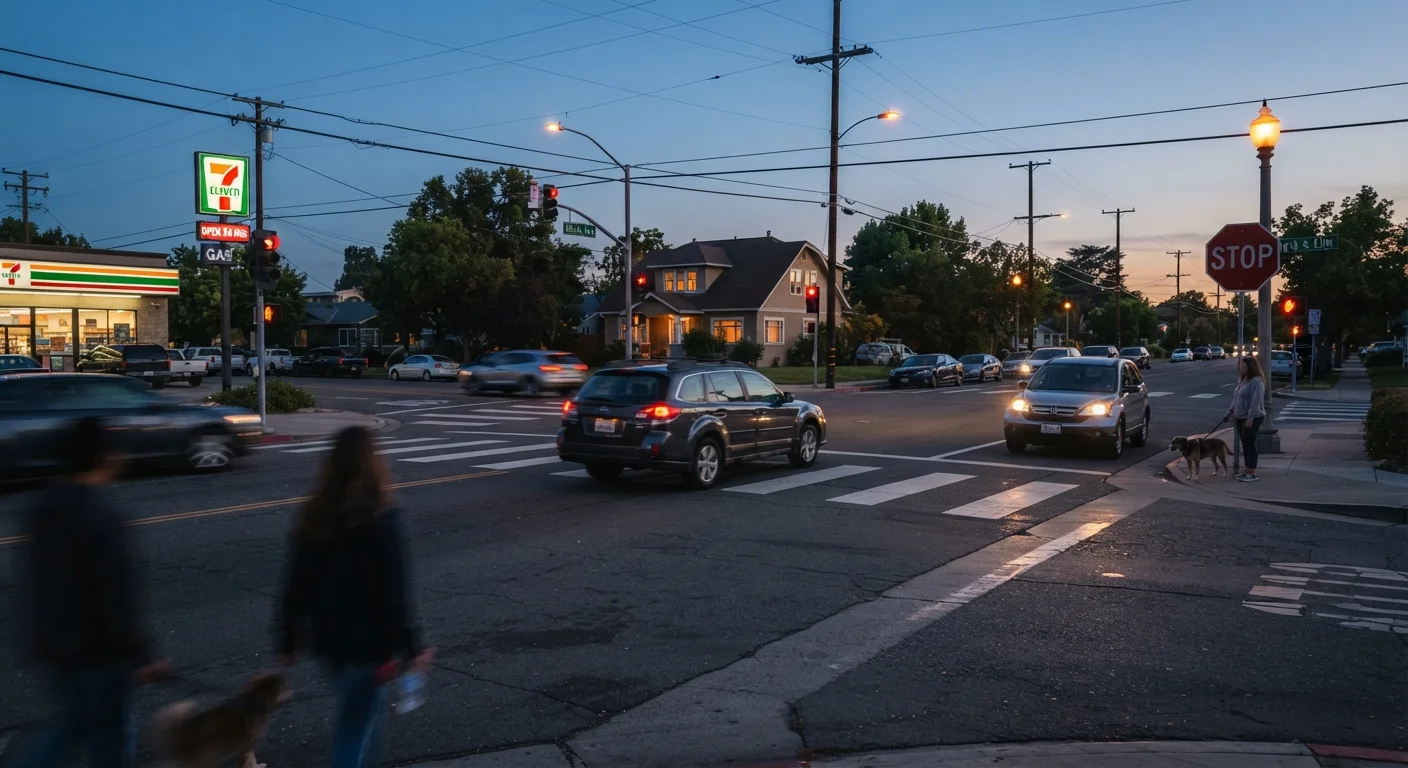
Photo credit: FaqsInsights.com | Stay Informed, Stay Ahead
In this article
Rolling stops, hands-free calls, and dim headlights — common driver habits that feel harmless but carry real risk according to road safety research.
Key Takeaways
- Hands-free phone calls impair driving nearly as much as holding a device, according to cognitive distraction research.
- Rolling stops - even at low speed - significantly increase pedestrian and cyclist injury risk at intersections.
- Dim or misaimed headlights can reduce effective forward visibility by hundreds of feet at highway speed.
- Tailgating feels normal in heavy traffic but collapses reaction windows for everyone involved.
- Overconfidence from driving experience can paradoxically increase risk-taking behavior on familiar routes.
Why Familiar Habits Feel Safer Than They Are
Most drivers who've had close calls or collisions weren't trying to take risks - they were doing what felt normal. That's precisely the problem. Road safety research consistently finds a gap between how dangerous a behavior actually is and how dangerous drivers perceive it to be. The habits that feel the most routine are often the ones that have become unexamined.
This isn't about recklessness. It's about how experience, repetition, and mild success at small shortcuts gradually erode the caution that keeps driving safe. Understanding where the research diverges from common assumption is the first step toward closing that gap.
Familiarity Is Not the Same as Safety
Many crash-involved drivers report they were on a familiar route and felt fully in control moments before impact. Research consistently shows that routine familiarity can suppress active hazard scanning. Feeling safe and being safe are two distinct states - and the gap between them is where preventable crashes occur.
Common Driving Myths - Corrected by Research
The myth-fact pairs below cover six widely held assumptions about safe driving behavior. Each one feels defensible in the moment - and each one is contradicted by traffic research when examined carefully.
Myth
Using a hands-free device while driving is essentially safe because my hands stay on the wheel.
Fact
Hands-free calling still produces significant cognitive distraction that impairs hazard detection and reaction time.
The assumption behind hands-free use is that danger comes from holding a phone - but research points elsewhere. The AAA Foundation for Traffic Safety has published studies demonstrating that mental workload from a phone conversation degrades a driver's ability to process what's happening on the road, even when both hands are on the wheel. Drivers using voice-activated systems were found to miss visual cues and react more slowly to sudden events. The issue is where your mind is, not just where your hands are.
Myth
A slow, rolling stop at a stop sign is safe enough if I can see no traffic is coming.
Fact
Rolling stops dramatically increase collision and injury risk, particularly for pedestrians and cyclists who may not be in your direct line of sight.
A rolling stop - sometimes called a "California stop" - feels reasonable when a road appears clear. But full stops exist precisely because a stationary vehicle gives a driver additional time to scan all approach angles, including crosswalks and blind spots. At low speeds, the margin between noticing a pedestrian and reacting in time is measured in fractions of a second. Traffic safety research consistently shows that failure to stop fully is a contributing factor in a disproportionate share of pedestrian-involved intersection crashes.
Myth
My headlights are on, so visibility at night is fine.
Fact
Standard low-beam headlights illuminate roughly 160 feet ahead - often far less than a vehicle's stopping distance at highway speeds.
Headlights being functional and headlights being adequate are not the same thing. At 60 mph, a vehicle needs approximately 240-300 feet to stop in ideal conditions. Standard low beams, if misaimed or clouded by degraded lenses, may light far less road than that. Night driving also compounds the problem through reduced peripheral vision and slower pupil adaptation. See our guide to night vision and driving for a closer look at how darkness affects the eye's performance behind the wheel.
Myth
Experienced drivers are safer because they've developed instincts that compensate for minor distractions.
Fact
Driver experience can reduce certain skill-based errors but does not protect against cognitive distraction, and may increase risk-taking on familiar routes.
Experience builds automaticity - the ability to perform basic vehicle control without much conscious thought. But that same automaticity can reduce active scanning on routes a driver knows well. Research on driver behavior has found that experienced drivers are not significantly more resistant to distraction than novices, and may underestimate risk due to a track record of incident-free driving. What actually keeps experienced drivers safe is disciplined habit - not accumulated years alone.
Myth
Following closely behind the car in front keeps traffic flowing and isn't really dangerous at moderate speeds.
Fact
Tailgating at any speed compresses reaction time and is a leading contributing factor in rear-end collisions.
At 40 mph, a driver needs roughly 1.5 seconds of reaction time before even touching the brakes - covering approximately 88 feet. A vehicle following too closely may have none of that buffer when the car ahead stops suddenly. The problem compounds in multi-car situations, where one driver's abrupt deceleration can ripple backward through several vehicles before anyone ahead has fully processed the event. Our related piece on how tailgating escalates minor slowdowns explains the chain-reaction dynamics in detail.
Myth
Speeding slightly over the limit - say, 5-10 mph - has a negligible effect on crash severity.
Fact
Even modest speed increases meaningfully extend stopping distances and raise the energy transferred in a collision.
Physics does not treat small speed differences as trivial. Kinetic energy increases with the square of speed, meaning a vehicle traveling at 40 mph carries significantly more crash energy than one at 30 mph - not just a proportional difference. Stopping distance also increases non-linearly with speed. For a detailed breakdown of why the numbers matter, see our article on speed and stopping distance. Speed limits are calibrated around roadway geometry, pedestrian presence, and measured stopping requirements - not arbitrary thresholds.
For drivers looking to build stronger foundational habits from the ground up, our article on defensive driving fundamentals covers the structured approach used in professional driver training. And for a broader look at how your scanning behavior affects hazard response time, see reading the road ahead.
Turning Awareness Into Habit
Knowing a behavior is riskier than it feels is necessary - but not sufficient. The practical step is converting that awareness into a repeatable routine. For distraction, that means treating any cognitively demanding conversation as a task that requires a pull-over, not just a hands-free device. For following distance, it means actively counting seconds between your front bumper and the vehicle ahead rather than relying on intuition.
Hands-Free Does Not Mean Risk-Free
Switching from a handheld phone to a hands-free device removes the manual distraction but preserves the cognitive one. Studies from the AAA Foundation for Traffic Safety found that voice-based tasks can create attention deficits lasting several seconds after the call ends. If a conversation is complex or emotionally loaded, consider pulling over safely before engaging.
Headlights deserve a periodic check beyond just confirming they turn on: lens clarity, aim angle, and bulb type all affect actual visibility range. For broader vehicle maintenance that affects safety on the road, see our guide to habits that shorten your car's lifespan. And for conditions where standard habits aren't enough - rain, ice, fog - our piece on adjusting for adverse weather provides condition-specific guidance.
The goal isn't anxiety about every mile driven - it's grounded awareness that keeps routine trips as safe as they feel.

Author
Cars & Driving Editorial Team
Cars & Driving Editorial Team is the collective byline for our editorial team and contributor network. Articles published under this byline or an editorial pen name are researched, written, and reviewed according to our editorial standards for clarity, consistency, and independence before publication.
View all articles →