
What Road Markings Actually Mean - and Why Drivers Get Them Wrong
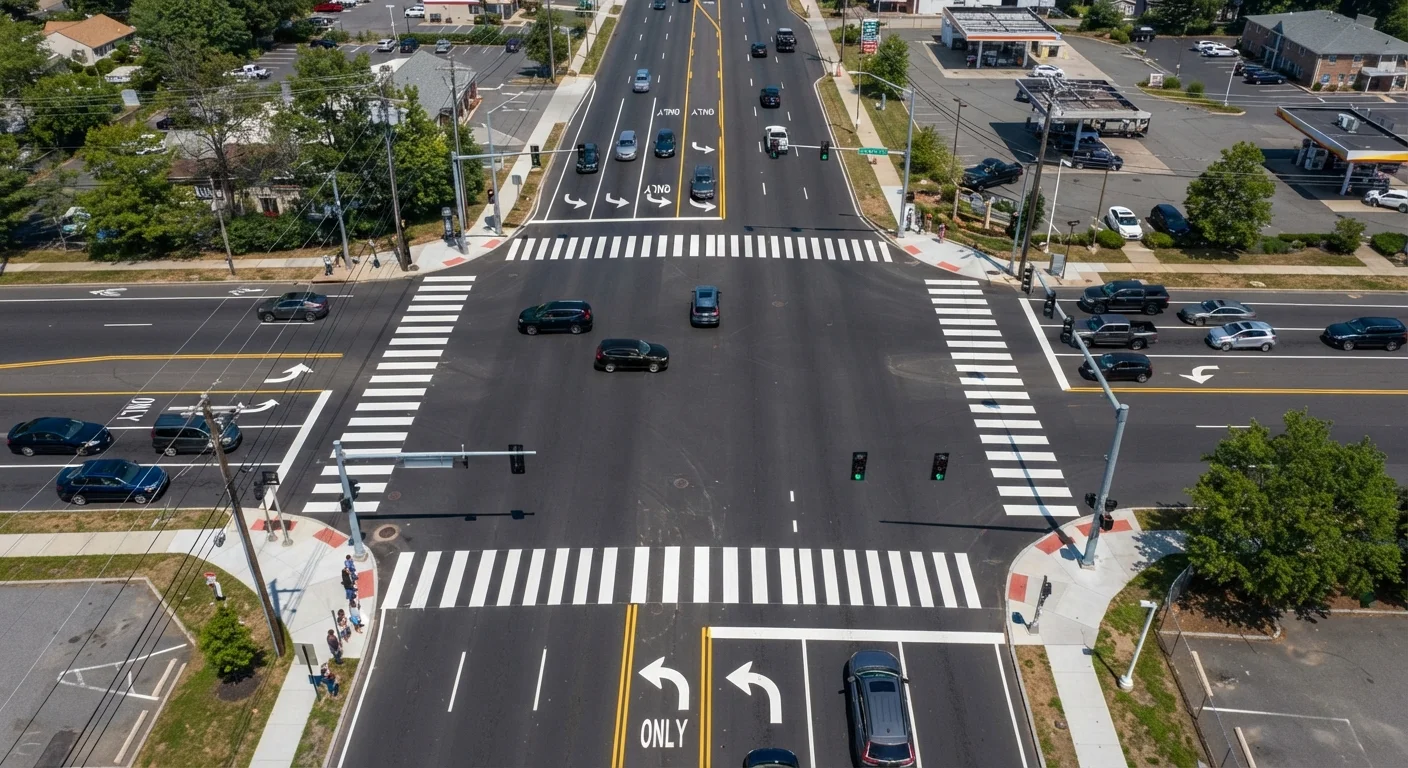
Photo credit: FaqsInsights.com | Stay Informed, Stay Ahead
In this article
Solid lines, broken lines, yellow vs. white — road markings carry specific legal meanings many drivers misread. A clear, state-informed reference guide.
The Color Code: What Yellow and White Actually Signal
Most drivers know road markings exist, but far fewer can accurately explain what any specific line requires of them. The U.S. uses a nationally standardized system - guided by the MUTCD, published by the Federal Highway Administration - that assigns precise meaning to color, pattern, and position.
| Color: Yellow markings | Separate traffic moving in opposite directions (MUTCD, Federal Highway Administration) |
| Color: White markings | Separate same-direction traffic or mark road edges (MUTCD, Federal Highway Administration) |
| Double solid yellow | No passing permitted in either direction (MUTCD standard; enforced by state traffic codes) |
| Broken line | Crossing permitted when safe and legal (MUTCD, Federal Highway Administration) |
| Solid white edge line | Marks the travel lane boundary; do not cross into shoulder (MUTCD, Federal Highway Administration) |
| Governing standard | Manual on Uniform Traffic Control Devices (MUTCD) (Federal Highway Administration, current edition) |
Yellow lines separate traffic moving in opposite directions. They appear on two-lane roads, divided highways, and the left edge of one-way streets. White lines separate traffic moving in the same direction, or mark the edges of the roadway itself.
This distinction matters because drivers routinely treat yellow and white centerlines as interchangeable visual cues. They are not. A yellow line signals that a vehicle on the other side of it is coming toward you. A white line separates you from a driver going the same way. Misreading that difference can lead to illegal passing maneuvers or dangerous lane changes.
Solid vs. Broken: What You're Legally Permitted to Cross
Pattern - solid versus broken - determines whether crossing a line is legal, restricted, or prohibited. Here's what each combination means in practice:
- Broken white line: Lane changes permitted when safe. This is the standard line between lanes of same-direction traffic on multi-lane roads.
- Solid white line: Crossing is discouraged and often restricted. Edge lines, gore areas near freeway exits, and turn-lane boundaries use solid white to signal that drivers should not cross.
- Broken yellow line: Passing is permitted when the road ahead is clear. Found on two-lane roads where both directions are allowed to pass.
- Solid yellow line (your side): Passing is prohibited for you, regardless of what's on the other side. If only one side is solid, that side cannot pass.
- Double solid yellow lines: Passing prohibited in both directions. Crossing for any reason other than a turn into a driveway or an emergency is illegal in virtually every state.
A common error: drivers treat a double yellow as a suggestion rather than a legal boundary. In most states, crossing a double solid yellow is a moving violation. Many habits that feel safe carry real legal and physical risk, and this is one of them.
MUTCD
The Manual on Uniform Traffic Control Devices, published by the Federal Highway Administration. It establishes the national standards for all road signs, signals, and pavement markings used in the United States.
Edge line
A solid white line painted along the outer boundary of a travel lane, indicating the edge of the road surface available to moving vehicles. Crossing it means leaving the lane.
Gore area
The triangular section of pavement between a through lane and an exit or entrance ramp. It is typically marked with a solid white line and diagonal stripes, and drivers should not travel through it.
Lane-use arrow
A pavement symbol painted inside a lane indicating which direction of travel is required or permitted from that lane - straight, left turn, right turn, or a combination.
Raised pavement marker
A reflective tab or button embedded in the road surface to supplement painted lane markings, especially useful in low-visibility or wet conditions. Colors follow the same convention as painted lines.
Centerline
The line dividing traffic flowing in opposite directions on a two-lane road. Yellow in color, it may be solid, broken, or a combination of both depending on passing rules at that location.
Specialty Markings Drivers Frequently Misread
Beyond basic lane lines, roads carry markings that communicate specific movement instructions. These are where driver confusion concentrates.
Turn and lane-use arrows
Pavement arrows inside a lane indicate which movement is required or permitted from that lane. A single arrow pointing straight means through travel only. A curved arrow means turns only. A combination arrow means either is allowed. Ignoring these markings - for example, going straight from a turn-only lane - is a traffic violation and a common cause of intersection collisions. Understanding how intersections are designed to manage traffic flow can help drivers interpret these cues correctly.
Rumble strips and edge lines
A solid white line running along the right edge of the roadway marks the limit of the travel lane. Crossing it onto the shoulder is not equivalent to staying in your lane. Rumble strips - milled grooves that generate noise and vibration - are placed near these edges specifically to alert distracted or fatigued drivers before they leave the road.
Bicycle lane markings
White-painted bicycle lanes, often accompanied by a bicycle symbol, are part of the roadway but reserved for cyclists. Motorists may cross them briefly to access a driveway or make a turn - but driving or parking within them is prohibited. Many drivers treat bicycle lanes as a shoulder or buffer zone, which creates serious hazards.
New and younger drivers are particularly likely to encounter gaps in this knowledge. Graduated licensing programs target specific risk factors, but pavement marking literacy is rarely tested with the depth these rules require.
State Variations and When to Look Closer
While the MUTCD sets national standards, states have some latitude in implementation. Raised pavement markers (reflective dots or tabs embedded in lanes) supplement painted lines in many states and carry the same directional color convention - yellow facing oncoming traffic, white facing same-direction traffic, red marking the wrong direction on one-way roads.
State Handbooks Are a Reliable Reference
Even experienced drivers benefit from reviewing their state's official driver handbook periodically. Pavement marking standards are covered in detail and are publicly available through each state's DMV. Rules around specific markings - such as center turn lanes or HOV lane boundaries - can have state-level nuances not immediately obvious on the road.
If you're driving in an unfamiliar state, consult that state's driver handbook for any local variations. Most are available free through the state's DMV website. For drivers responsible for a vehicle's upkeep alongside its safe operation, understanding your ownership responsibilities as a whole builds a stronger foundation on the road.

Author
Cars & Driving Editorial Team
Cars & Driving Editorial Team is the collective byline for our editorial team and contributor network. Articles published under this byline or an editorial pen name are researched, written, and reviewed according to our editorial standards for clarity, consistency, and independence before publication.
View all articles →