
Roundabouts vs. Traditional Intersections: Who Moves, Who Waits, and Why It Matters
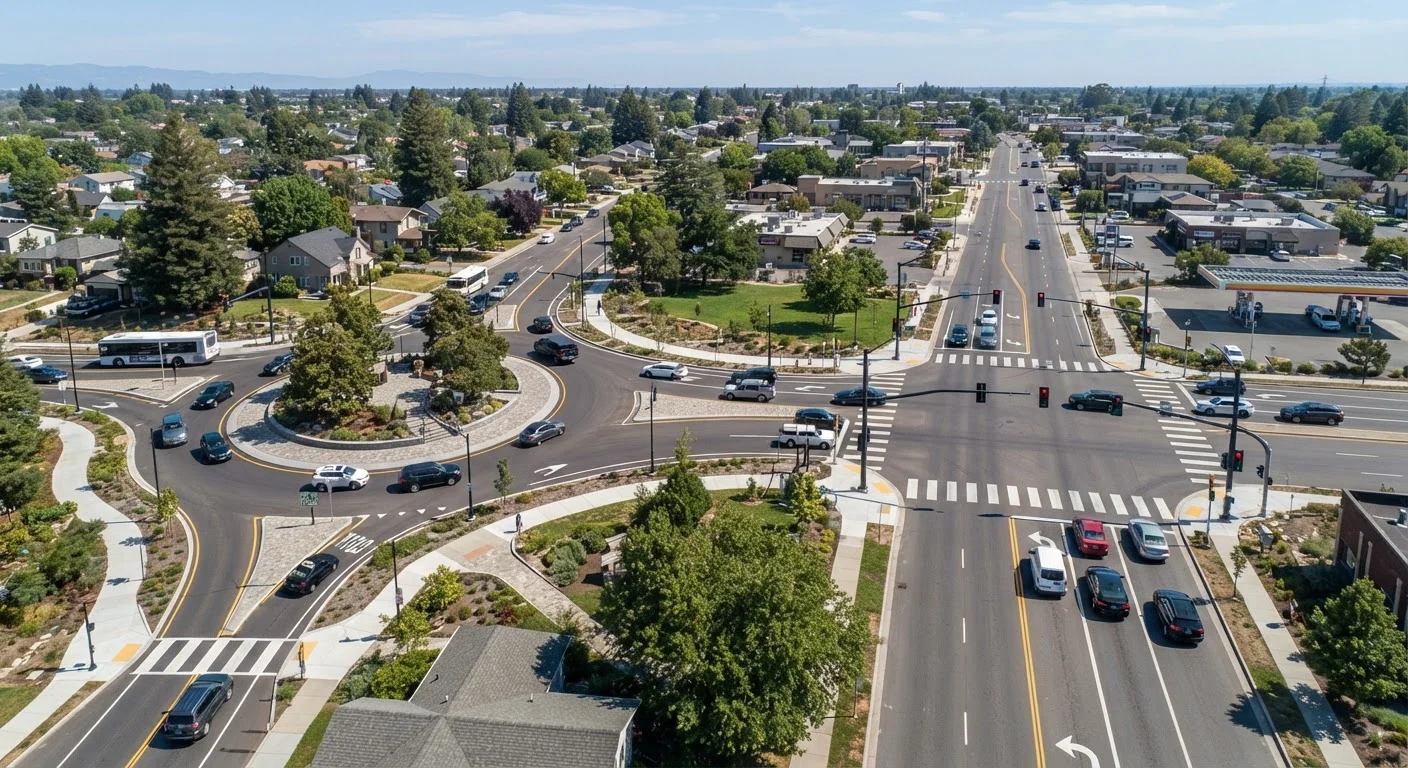
Photo credit: FaqsInsights.com | Stay Informed, Stay Ahead
In this article
Many US drivers find roundabouts confusing. This side-by-side breakdown explains how each intersection type works and what the safety data shows.
Key Takeaways
- Roundabouts eliminate the right-angle crash angle responsible for the most fatal intersection collisions.
- Traditional signalized intersections handle complex, high-volume, multi-lane traffic more predictably for many drivers.
- Research by the Insurance Institute for Highway Safety shows roundabouts reduce fatal and injury crashes significantly compared to stop-sign and signal-controlled intersections.
- Yielding to circulating traffic - not stopping completely - is the core rule every roundabout driver must internalize.
- Neither intersection type is universally safer; context, design, and driver behavior all determine real-world outcomes.
How Each Intersection Type Actually Works
At a traditional intersection - whether controlled by traffic signals or stop signs - drivers take turns moving through a shared conflict zone based on explicit right-of-way rules. Red means stop, green means go, and left-turn arrows carve out protected windows. The logic is sequential: one stream of traffic moves while all others wait.
A roundabout works on an entirely different principle. Instead of a controlled stop-and-go sequence, vehicles travel counterclockwise around a central island. Drivers entering the roundabout must yield to traffic already circulating inside - there are no signals dictating who goes when. Once a gap opens, you enter, travel to your exit, and leave. Movement is nearly continuous rather than batch-processed.
Understanding what road markings mean inside a roundabout - yield lines, lane dividers, and directional arrows - is essential to using them correctly. Many US drivers misread these markings or ignore them entirely, which contributes to avoidable conflicts.
| Criterion | Roundabout | Traditional Intersection |
|---|---|---|
| Right-of-way rule | Yield to circulating traffic | Follow signals or signs |
| Traffic flow pattern | Continuous, counterclockwise | Sequential, stop-and-go |
| Fatal crash risk | Significantly lower by design | Higher due to right-angle conflicts |
| Pedestrian handling | Crosswalks outside the circle, lower speed | Dedicated signal phases available |
| Driver learning curve | Steeper for unfamiliar drivers | Familiar, well-established cues |
| High-volume performance | Efficient at moderate volumes | Better managed with signal timing |
| Common crash type | Sideswipe, rear-end on entry | Right-angle, rear-end, left-turn |
What the Safety Data Actually Shows
The safety record of roundabouts in the United States is well-documented. The Insurance Institute for Highway Safety (IIHS) has found that converting stop-sign or signal-controlled intersections to roundabouts reduces injury crashes by roughly 75 percent and fatal crashes by an even higher margin. The geometric reason is straightforward: roundabouts eliminate the right-angle crash - the type where one vehicle strikes another broadside at full speed - because all traffic moves in the same direction at reduced speeds.
Traditional intersections are not inherently dangerous, but they do concentrate certain high-severity crash types. Red-light running, for instance, creates exactly the T-bone scenario roundabouts structurally prevent. According to the IIHS, red-light running contributes to hundreds of fatalities annually at signalized intersections in the US.
~75%
Reduction in injury crashes at converted roundabouts
According to the Insurance Institute for Highway Safety (IIHS), intersections converted from signals or stop signs to roundabouts show dramatic reductions in injury-producing crashes.
~90%
Reduction in fatal crashes at roundabout conversions
IIHS research indicates fatal crash rates fall by approximately 90% when traditional intersections are replaced with roundabouts, largely due to lower speeds and eliminated right-angle conflicts.
Hundreds
Annual US fatalities linked to red-light running
The IIHS reports that red-light running - a primary risk at signalized intersections - contributes to hundreds of deaths on US roads each year.
That said, traditional intersections can outperform poorly designed roundabouts. A roundabout with inadequate sight lines, confusing lane assignments, or inappropriate placement on a high-speed arterial can introduce new hazards. Design quality matters as much as intersection type. Drivers who apply the habits of experienced drivers - scanning early, adjusting speed proactively, and reading lane markings - are better equipped to handle both formats safely.
Common Mistakes Drivers Make at Each Type
At roundabouts, the most frequent errors include:
- Failing to yield at entry - treating the yield line like a stop sign creates rear-end risk; treating it like it doesn't exist creates broadside risk with circulating vehicles.
- Wrong lane selection - in multi-lane roundabouts, choosing the wrong lane for your intended exit is a common source of weaving and late maneuvers.
- Stopping inside the roundabout - once you've entered and have the right of way, stopping disrupts flow and confuses drivers behind you.
At traditional intersections, the recurring problems are different:
- Rolling stops at stop signs - a habit many drivers don't recognize as genuinely risky, though traffic research says otherwise.
- Misjudging yellow lights - accelerating through a late yellow rather than braking is a leading trigger for right-angle crashes.
- Left-turn assumptions - assuming oncoming traffic will stop during a protected phase, or assuming a permissive left is clear when it isn't, causes a disproportionate share of serious crashes.
For newer drivers especially - including those navigating graduated licensing restrictions - intersections of both types demand active attention rather than passive reflex.
Multi-Lane Roundabouts Require Extra Attention
Single-lane roundabouts are generally straightforward once the yield rule is clear. Multi-lane roundabouts introduce lane-discipline demands similar to highway driving - drivers must select the correct entry lane based on their intended exit before they reach the yield line. Changing lanes inside a multi-lane roundabout is both dangerous and, in most states, illegal. If you're uncertain, entering in the outer lane and exiting at the first available opportunity is a conservative but valid choice.
Choosing the Right Mindset for Each
The practical takeaway isn't that one intersection type is better and the other should be avoided. It's that each demands a different mental model from the driver. Traditional intersections reward patience and signal-watching. Roundabouts reward spatial awareness and smooth speed management - skills also relevant when merging onto a highway, where reading gaps and matching speed are the core tasks.
As US communities continue converting older intersections to roundabouts - a trend accelerating in many states - driver familiarity will grow over time. In the meantime, slowing to a comfortable speed on approach, reading the yield line correctly, and resisting the urge to stop when you don't need to will carry most drivers through any roundabout without incident.
Neither format is forgiving of distraction, overconfidence, or speed. The geometry changes; the need for active, attentive driving does not.

Author
Cars & Driving Editorial Team
Cars & Driving Editorial Team is the collective byline for our editorial team and contributor network. Articles published under this byline or an editorial pen name are researched, written, and reviewed according to our editorial standards for clarity, consistency, and independence before publication.
View all articles →