
How Tailgating Turns Minor Slowdowns Into Multi-Car Pileups
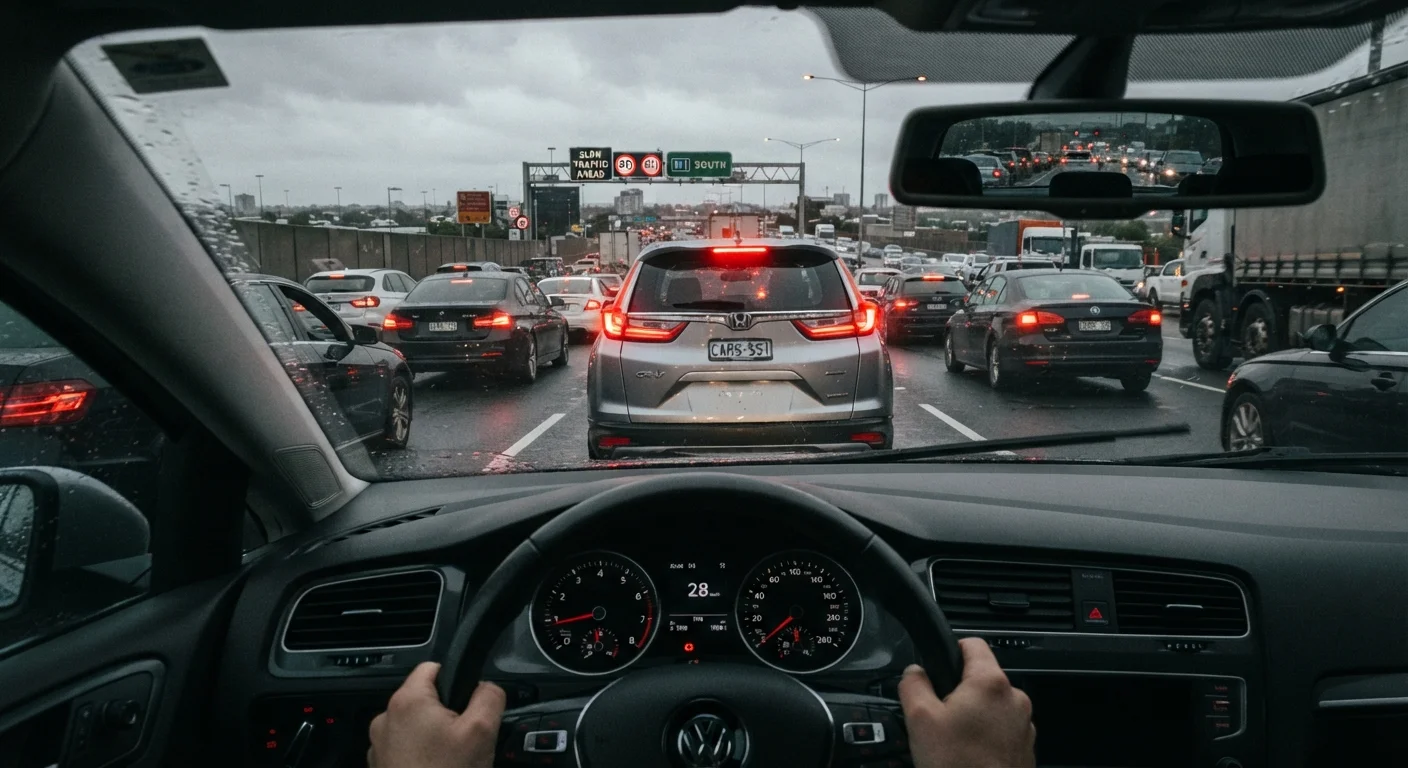
Photo credit: FaqsInsights.com | Stay Informed, Stay Ahead
In this article
Tailgating isn't just aggressive—it collapses the reaction window for everyone behind you. Here's the chain-reaction math and how to break the pattern.
Key Takeaways
- Tailgating collapses your reaction window and the reaction windows of every driver behind you.
- At 65 mph, a one-car-length gap gives you roughly half the time you need to stop safely.
- Rear-end crashes are among the most common collision types on U.S. roads, and following distance is a primary factor.
- Increasing your following distance to three or more seconds also reduces brake-riding and fuel waste.
- Weather, speed, and vehicle load all require extending the gap beyond the standard three-second rule.
Why One Car's Brakes Become Everyone's Problem
Traffic engineers refer to it as a shockwave: a ripple of braking that travels backward through a stream of vehicles far faster than the original cause would suggest. When a driver three cars ahead taps the brakes for a merging truck or a pothole, the effect should be minor - a gentle deceleration absorbed smoothly by the cars behind. But that only works when each driver has enough space to react and brake gradually.
Tailgating destroys that cushion. When following distances collapse to one or two car lengths at highway speeds, each successive driver must brake harder than the one ahead - a phenomenon called brake amplification. What started as a 5 mph slowdown at the front of the chain can arrive at the rear as a near-complete stop, long after the original trigger has resolved. Drivers at the back never even see what started it.
This is not a theoretical concern. Rear-end collisions consistently account for a significant share of all police-reported crashes in the United States, and following-too-closely is repeatedly cited among the contributing factors in crash data collected by the National Highway Traffic Safety Administration (NHTSA). Understanding the chain-reaction math - not just the rule - is what changes driver behavior. For a deeper look at how scanners habits affect your available reaction time, see structured road-scanning techniques used in professional driver training.
The Reaction-Time Math That Most Drivers Get Wrong
The average driver takes roughly 1.5 seconds to perceive a hazard and begin braking - and that figure assumes alert, undistracted conditions. At 65 mph, that 1.5 seconds of perception-reaction time translates to approximately 143 feet of travel before your foot even touches the brake pedal. Your vehicle then needs additional distance to actually stop, depending on speed, load, and road conditions.
A one-car-length gap at highway speed - roughly 15 feet - offers a fraction of that required distance. Even two car lengths falls well short. The three-second rule is the widely taught minimum, but as following distance research shows, speed, weather, and vehicle weight all shift that threshold upward. In rain or on worn tires, four or five seconds may be the true minimum.
~143 ft
Distance traveled before braking begins at 65 mph
At average perception-reaction time of 1.5 seconds, a vehicle traveling at 65 mph covers roughly 143 feet before the driver's foot reaches the brake pedal.
29%
Share of crashes that are rear-end collisions
According to NHTSA crash data, rear-end collisions represent roughly 29% of all police-reported crashes in the United States, making them one of the most prevalent collision types.
5x
Brake force amplification in tightly packed traffic
Traffic flow research has documented that brake inputs can amplify by a factor of five or more between the front and rear of a densely packed vehicle chain during a shockwave event.
What makes tailgating especially dangerous in multi-lane traffic is the cascade effect on adjacent lanes. Drivers who panic-brake often swerve, pulling other lanes into the chain reaction. A single rear-end contact near highway speed can set off a sequence that involves vehicles that never touched the triggering car.
Common Tailgating Mistakes - And How to Break Them
Maintaining highway-speed following distances of one to two car lengths.
Why it happens: Drivers calibrate distance visually based on what seems 'normal' in surrounding traffic, not on stopping physics. Dense traffic normalizes dangerously short gaps.
Assuming your reaction time is faster than average because you feel alert.
Why it happens: Drivers tend to overestimate their own reflexes, particularly when conditions feel familiar or routine. This leads to gaps that feel adequate but aren't.
Tailgating slow-moving vehicles to signal impatience or prompt them to move.
Why it happens: Drivers who feel blocked or frustrated instinctively close distance as a social signal. This is a behavioral impulse, not a conscious safety decision.
Following at the same distance regardless of speed, weather, or vehicle type.
Why it happens: Many drivers learned a fixed distance rule - '200 feet' or 'two car lengths' - rather than a time-based or condition-adjusted method, leading to underestimating the gap needed at higher speeds or in poor conditions.
Failing to increase following distance after a car merges into your buffer.
Why it happens: A vehicle entering the gap feels like a gap loss rather than a neutral event, triggering an instinct to close back up to reclaim the 'lost' space.
Many of these patterns are interconnected. Hard braking caused by tailgating also accelerates brake wear and suspension stress - habits that compound over time as described in our look at everyday habits that quietly shorten a car's lifespan. Addressing following distance isn't just a safety decision; it's a maintenance one too.
Distraction Multiplies Tailgating Risk
Even a one-second glance at a phone or infotainment screen erases any margin a short following gap might offer. At 65 mph, one second of inattention equals roughly 95 feet of blind travel - more than six car lengths. Tailgating while distracted removes any realistic chance of avoiding a sudden stop ahead. Keep eyes forward and the gap generous.
Building the Gap-Keeping Habit
Knowing the risk and changing the behavior are different things. Most drivers who tailgate aren't trying to intimidate - they've simply normalized the distances they see around them. On a congested highway where everyone is following closely, a three-second gap feels enormous and invites other drivers to merge in front of you. That perception is both accurate and worth accepting: a car merging into your buffer is not a threat. It briefly reduces your gap, which you restore by easing off the accelerator.
The practical technique is simple: pick a fixed point on the road - a sign, a lane marking, a bridge shadow - and count the seconds between when the vehicle ahead passes it and when you do. If you reach three seconds before finishing the count, you're too close. This works at any speed and doesn't require guessing distances.
Drivers who consistently apply gap management report that highway driving becomes noticeably less fatiguing - fewer micro-corrections, less brake-riding, and smoother speed maintenance. These same qualities define the repeatable habits experienced drivers rely on to stay crash-free across years of high-mileage driving.
One additional benefit: better following distance expands your forward visibility. You can see farther down the road, which gives you earlier warning of slowdowns and lets you brake gradually rather than suddenly - which in turn protects every driver behind you. It also aligns with the broader truth that many habits that feel safe carry real risk once the data is examined.
Your Gap Protects the Driver Behind You
Maintaining a proper following distance isn't only about your stopping ability - it directly shapes how much time the driver behind you has to react. When you brake gradually from a safe distance, the driver behind sees your taillights earlier and has room to respond smoothly. When you brake suddenly from a short gap, that abrupt signal travels backward through traffic, compressed and amplified at each vehicle. Your following distance is a courtesy and a safety measure for everyone in the chain, not just yourself.

Author
Cars & Driving Editorial Team
Cars & Driving Editorial Team is the collective byline for our editorial team and contributor network. Articles published under this byline or an editorial pen name are researched, written, and reviewed according to our editorial standards for clarity, consistency, and independence before publication.
View all articles →